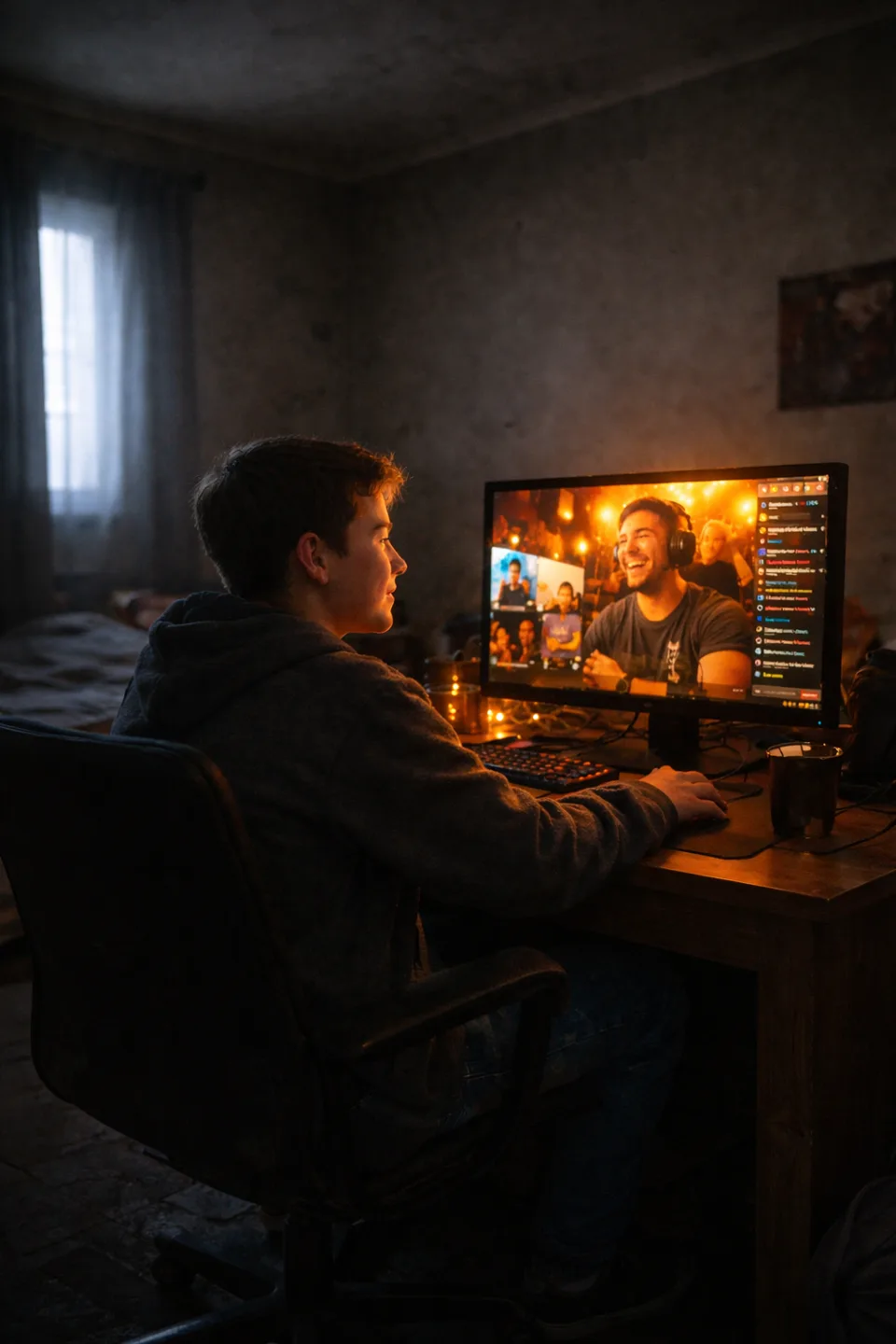
I love watching streamers online.
Not ironically. Not anthropologically. Not as some detached elder standing at the edge of digital civilization with a clipboard and concern. I mean I actually love them.
I love the rhythm of them, the chaos, the bits, the running jokes that somehow become culture. I love the strange intimacy of watching a person make a small temporary world out of a room, a game, a camera, and a chat full of absolute lunatics. There is something deeply human in it: messy, stupid, occasionally transcendent, often pointless in the best possible way. And the older I get, the more I think adults should spend a little more time understanding what boys are actually finding there.
This thought sharpened for me while watching Louis Theroux’s new Netflix documentary Inside the Manosphere, which looks at the growing influence of extremist male influencers on boys and young men. The men in that film are exactly the kind of people I would want my child to avoid. That part did not confuse me. What stayed with me afterward was something else: I kept wishing the documentary would show the other half of the coin.
Because the mainstream adult framing of the internet is becoming so flattened, so moralized, so embarrassingly low-resolution, that it barely qualifies as thinking anymore. Online bad. Games bad. Streamers bad. Boys in danger. Throw the router into a river and hand everyone a wooden spoon. That is roughly the level of analysis we are working with.
And to be clear, some of the fear is earned. There are absolutely toxic forces online. The manosphere is real. There are men who have built entire business models around converting male confusion into ideology. They take loneliness, humiliation, sexual frustration, uncertainty, and pain, and they transmute it into a story about dominance, about women as threat, about softness as failure, about kindness as weakness, about life as a permanent hierarchy in which you either become untouchable or get crushed.
It is a grim little religion, and like most grim little religions, it mistakes emotional damage for truth.
So yes, that world exists. And yes, boys are seeing it. But it is not the whole internet.
That is the part I kept wanting to say while watching Theroux’s documentary. Yes, this is real. Yes, this matters. Yes, parents should pay attention. But where is the other half of the male internet? Where are the boys spending hours with streamers who are chaotic, ridiculous, loud, immature, bizarre, and very much online, but are not trying to turn male insecurity into an ideology? Where are the figures who are not selling grievance, domination, misogyny, or paranoia, but something much more ordinary and much more useful: humor, atmosphere, belonging, play, restraint, and a way of being around other people that does not require becoming a monster?
Because boys are not only going online in search of ideology. Most of the time, they are not going online for a doctrine at all. They are going online for atmosphere, for tone, for energy, for belonging, for humor, for repetition, for a sense of place, for an answer to the question: what does it feel like to be around a man like this?
That question matters more than people think.
Because boys are always learning from men, even when no one announces that learning is taking place. They are learning from speech patterns, reactions, posture, restraint, cruelty, softness, humor, what gets mocked, what gets protected, how someone handles embarrassment, how someone handles power, what someone does when tested, what someone does when no grand principle is at stake and they are simply moving through the world. That is education too. Just not the kind with a credential.
And that is why I think adults should pay attention to streamers. Not because every streamer is a role model. That would be insane. I am not trying to baptize Twitch. I am saying something simpler and, to me, more obvious: there is a profound difference between a man online who is teaching boys to become harder, colder, more suspicious, more dominant, more sealed off from their own humanity, and a man online who is simply demonstrating another way to exist.
That difference matters.
Take Gymskin.
What is fascinating about him is that he looks like the kind of guy many adults have already been trained to distrust. He is in shape. He cares how he looks. He moves through England with the easy confidence of someone who appears to own several invisible properties in whatever neighborhood he is standing in. He has the visual silhouette of a certain kind of internet male figure. If you described him badly enough, a nervous journalist could probably turn him into a cautionary tale before lunch.
And yet what he often models is almost the inverse of manosphere logic. He helps elderly people cross the street. He speaks respectfully to people different from him. He moves through public space with confidence but not contempt. And maybe most importantly, when conflict comes to him, he does not always make a theater of retaliation. He can turn his back, walk away, and speak to his chat about being better than the impulse to escalate.
That is not weakness. That is form.
The manosphere cannot understand that because it is spiritually organized around humiliation. It is haunted by the fear of being diminished, embarrassed, laughed at, disrespected, overlooked, feminized, made small. So it teaches boys to strike first psychologically, socially, rhetorically, sexually — always to armor up before life can touch them.
But Gymskin, at his best, models something more integrated. He offers a version of masculine presentation that still looks legible to boys who are paying attention to status, strength, and appearance. He does not reject those things. He inhabits them. And then he refuses the uglier script that usually gets attached to them. He shows that you can be handsome, physically fit, socially confident, and still behave like the world contains other people. You can look like that and still act with respect. You can carry presence without turning it into intimidation.
That is a real intervention, whether people know how to name it or not.
Then there is CaseOh, who offers almost the opposite energy and arrives at something equally important. CaseOh does not radiate sleek masculine control. He radiates something much more alive: openness, absurdity, comic largeness, emotional visibility. He is not selling boys the fantasy of becoming untouchable. He is showing them that a man can be fully there — fully seen, fully joked with, fully ridiculous, fully himself — and survive it.
That matters more than people realize.
A lot of toxic masculinity is built on one central fear: humiliation. Not pain, exactly. Not failure, exactly. Humiliation. The fear of being seen and found lacking. And because of that fear, so many male internet figures become obsessed with control. Control your image. Control women. Control emotion. Control outcomes. Control narrative. Never be the one exposed. Never be the one laughed at. Never be the one needing anything.
CaseOh breaks that spell a little. There is a looseness to him, a humanity, a willingness to let humor level the room rather than sharpen it into hierarchy. He brings people in. Different cultures, different kinds of people, different tones. And he does not let his chat freely rot into disrespect. That is not a side detail. That is part of the whole thing. He creates a space where the joke does not have to rely on contempt as its main fuel source.
That too is a model of masculinity. Not the sermon version. The ambient version. The version boys actually absorb.
And then there are people like Jynxzi and Sketch and others in that broad world of male online personalities who may be ridiculous, over-the-top, adolescent, awkward, or chaotic, but who are still not operating out of the same dark engine. They are not trying to convert vulnerability into misogyny. They are not recruiting boys into a total worldview of resentment. They are offering something looser, stranger, and in its own way healthier: sociality, play, shared language, comic energy, and the permission to be a person instead of a fortress.
Because this is the deeper truth, I think: boys do not become men through argument alone. They become men through atmosphere. Through repetition. Through vibe. Through who makes them laugh. Through what kinds of behavior are normalized around them. Through what emotional tones feel available. Through which forms of male presence feel magnetic.
The manosphere understands this, which is why it is so effective. It does not merely offer opinions. It offers a felt identity, a costume for pain, a shape for disorientation. It tells boys: here is how to interpret your loneliness. Here is how to convert uncertainty into superiority. Here is how to become the kind of man who never has to feel small again.
It is poison, yes. But it is emotionally coherent poison.
Which means the answer cannot just be panic. Or abstinence. Or adults repeating “screens are bad” like medieval peasants describing an eclipse. The answer has to be better models, better atmospheres, better examples of male aliveness.
And that is where streamers matter.
Not all streamers. Obviously. Some are corrosive. Some are manipulative. Some are empty in ways that quietly deform the people watching them. I am not arguing the internet is innocent. It is not. I am not arguing that streamers are saints. Dear God, no. I am arguing for discernment. For actually looking. For recognizing that the same digital ecosystem that contains men monetizing resentment also contains men modeling humor, respect, self-possession, pluralism, restraint, and basic decency.
If adults cannot distinguish between those things, then what they have is not moral clarity. It is aesthetic disgust disguised as wisdom.
And let’s be honest, some of the contempt adults feel toward streamers is just that: aesthetic. Streamers can seem loud, repetitive, juvenile, pointless. Which is true. So is half of life. Hanging out is pointless. Inside jokes are pointless. Playing a game while your friends talk nonsense is pointless. So is standing in a driveway for two hours after dinner talking about absolutely nothing, and yet that somehow still counts as meaningful human bonding.
Not everything valuable arrives dressed like a TED Talk.
Sometimes what is healing is stupid. Sometimes what is healthy looks unserious. Sometimes what saves a person is not a lesson but a tone.
That is what I think adults miss.
A boy who spends time around contempt will internalize contempt. A boy who spends time around humiliation will internalize humiliation. A boy who spends time around men obsessed with domination will begin to mistake domination for depth. But a boy who spends time around men who are funny, socially alive, decent, expressive, self-possessed, and not fundamentally at war with the world may internalize something else.
Not perfection. Not sainthood. Just a better baseline for being human.
And maybe that is the point.
Maybe the real choice is not between the internet and some fantasy of pure offline innocence. That fantasy is over. The internet is part of reality now. The question is not whether boys will encounter masculinity online. They will. The question is: what kind?
Will they be taught that to be a man is to become a fortress? Or will they see that it is possible to be visible without vanity, strong without aggression, funny without cruelty, attractive without narcissism, confident without contempt?
That is why figures like Gymskin, CaseOh, Jynxzi, and Sketch matter to me. Not because they are perfect representatives of some ideology I want to impose. Not because I need them to become moral heroes. But because, in different ways, they interrupt a lie.
The lie is that male power must become cruelty. The lie is that male confidence must become domination. The lie is that to be seen as a man, you must deaden the parts of yourself that make you relational, playful, or kind.
No.
You can look like Gymskin and walk away. You can be like CaseOh and make the room bigger. You can be loud and ridiculous like Jynxzi or Sketch without turning your whole presence into a politics of resentment. You can be a man online and not turn your audience into collateral damage.
That matters.
Especially now, when so much of culture is trying to force boys into brittle little templates of what strength is supposed to look like. Boys do not need more men teaching them how to be feared. They do not need more men teaching them how to convert insecurity into performance art. They do not need another emotionally constipated guru explaining the geometry of dominance from inside a rented supercar.
They need more examples of men being fully human and not collapsing from the exposure.
That is part of why I love streamers.
Not because the internet is safe. Not because every creator is good. Not because this is some utopian defense of digital life.
But because if you look closely, beneath all the noise, something real is happening there. Boys are learning. Not always from the men adults are panicking about most. Sometimes from someone joking with their chat. Sometimes from someone refusing to escalate. Sometimes from someone making people laugh without making another person smaller. Sometimes from a man who looks like he could become a cliché and simply chooses not to.
And in a culture this confused about masculinity, that is not nothing.