There is something uniquely American about watching a political party stare directly into the consequences of its own failures and conclude, with perfect confidence, that the answer is to do the same thing again, only with better slogans, more consultants, and a fresh email subject line about democracy being on the ballot..
It would be funny if it were not so exhausting.
We are entering that familiar season when the donor class, party operatives, and professional normal people begin assembling themselves like a Voltron of caution. The stakes, they tell us, have never been higher. Fascism is at the door. The republic is trembling. History is calling. And after all the apocalyptic throat-clearing, the great strategic insight appears to be this: let’s rerun the same basic formula that helped produce the crisis in the first place.
That is the part I cannot get over.
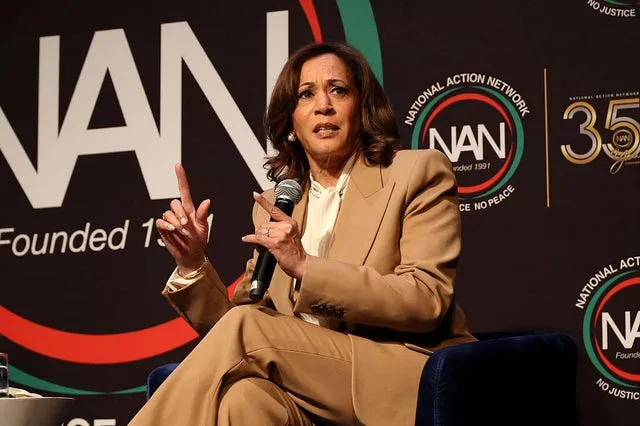
Not because Kamala Harris is some uniquely terrifying figure. She is not. To me, she reads as Republican Lite, which in our broken political dialect means someone who would likely restore a degree of procedural sanity, smooth out the tone, lower the fever, and help respectable institutions feel like they can unclench their jaw for a few years. In another era, that might have sounded sufficient. In this one, it sounds like a national sedative.
And maybe that is the appeal. After the chaos, the corruption, the grotesque spectacle, the cruelty packaged as authenticity, plenty of people want a reset. They want normal. They want brunch to feel apolitical again. They want to stop doomscrolling and start pretending the machine is fundamentally sound.
But normalcy is not resolution.
That is the scam. That is the crutch holding up the whole cycle. A return to normal is not the same thing as addressing the conditions that made abnormality attractive in the first place. You do not cure a political disease by temporarily reducing visible swelling. You do not defeat a movement by replacing it with a softer voice reading from the same script of managed decline, elite insulation, and permanent almost-change.
If anything, that pattern is how you fertilize the ground for something worse.
The formula is almost elegant in its stupidity. First, a population gets economically and spiritually hollowed out for decades while every institution keeps insisting this is progress. Then an authoritarian vulgarian arrives and translates that rage into a cartoon religion of grievance, spectacle, and revenge. Everyone recoils, rightly horrified. The opposition responds not with transformation, not with rupture, not with a serious confrontation with why so many people became receptive to the grotesque in the first place, but with a restoration package. A return to normal. A sleeker manager for the same haunted house.
Then, because the underlying conditions remain, because the despair remains, because the alienation remains, because political imagination is still trapped inside a donor-approved petri dish, the pressure builds again. And what emerges next is often meaner, smarter, and less embarrassed than the last creature.
This is what terrifies me. Not Kamala Harris herself. Not some singular ideological threat. What terrifies me is the possibility that the official opposition to a movement they describe as existential still seems incapable of grasping that moderation in style is not adequacy in substance. That institutional familiarity is not electability. That name recognition is not charisma. That “not insane” is not a governing vision capable of reversing collapse.
You cannot keep telling people the house is on fire and then ask them to get excited about a slightly better fire marshal who promises to preserve the floor plan.
And there is something darkly hilarious about all of it. The same people who would mock ordinary citizens for repeating bad relational patterns will turn around and engineer the exact same political dynamic every four years, then stare into the camera as though they have discovered fire. They keep trying the same thing over and over, but because they wear lanyards and appear on cable news, we are apparently supposed to call it pragmatism instead of pathology.
At some point you want to grab the entire political establishment by the lapels and ask: do you actually want to stop this cycle, or do you just want to remain the respectable management team assigned to narrate it?
Because those are not the same goal.
Maybe Harris would, in fact, represent a reset toward procedural normalcy. Maybe she would appoint competent people, speak in complete sentences, and project the general aura of someone who has read a memo without trying to mate with it on live television. Fine. Great. Wonderful. But if the deeper pattern remains untouched, if all we are doing is pausing the spiral instead of breaking it, then normal becomes less a cure than an intermission.
And intermissions have a nasty habit of ending.
What I keep coming back to is simple: if your answer to a legitimacy crisis is branding, if your answer to democratic decay is managerial polish, if your answer to rising extremism is a candidate whose primary appeal is familiarity to the architecture of power, then you are not solving the problem. You are preserving the conditions under which it mutates.
Normalcy is not resolution.
It is the sedative administered between convulsions.