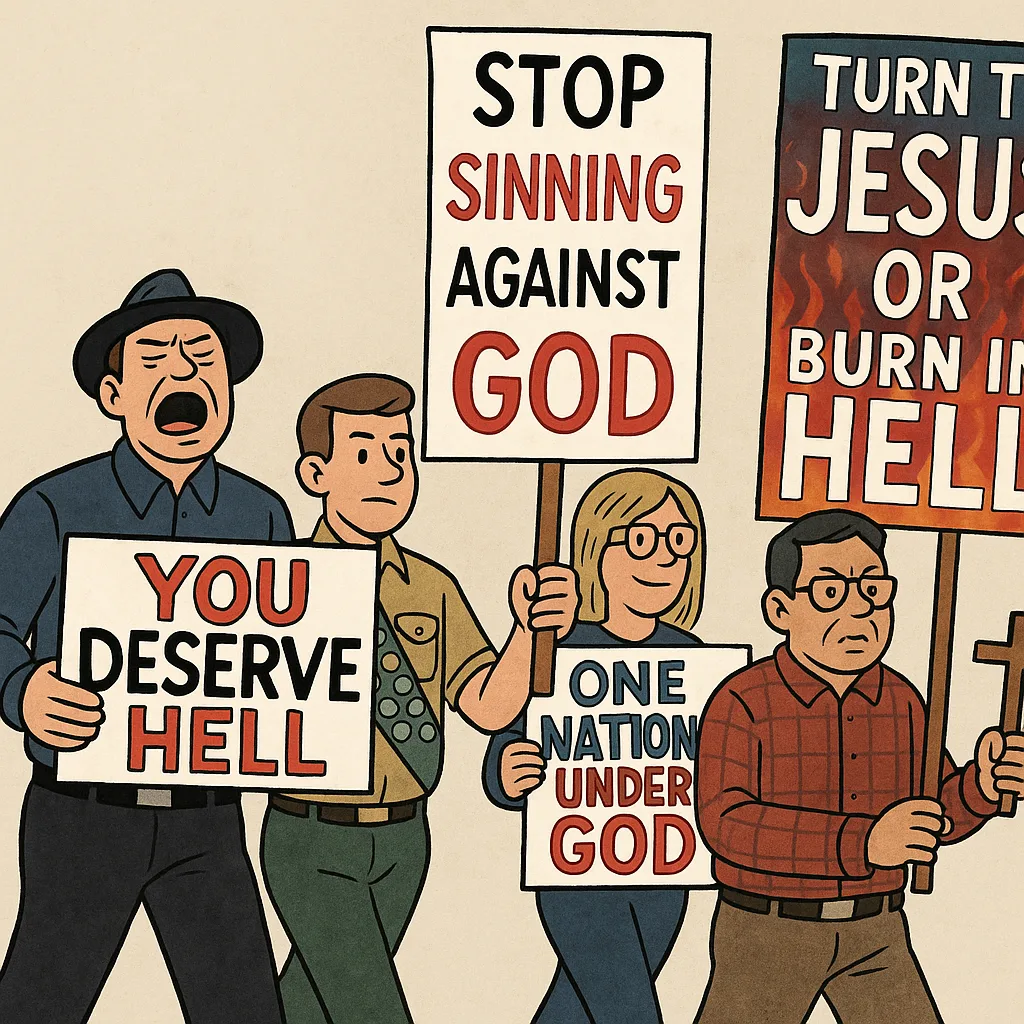
There’s a phrase that’s been circling lately that stops me in my tracks every time I hear it: “There is no hate like Christian love.” At first it sounds like irony, a clever reversal. But the more I look at what the American Christian movement has become, the more I realize it isn’t irony at all. It’s diagnosis.
Christianity, at its roots, is a faith of embodiment. Love your neighbor as yourself. What you do to the least, you do to God. It is easier for a camel to pass through the eye of a needle than for the rich to enter the kingdom of heaven. These teachings aren’t about ownership or control—they’re invitations to embody love, humility, and presence. To live them, not just proclaim them.
But somewhere in the long detour from Palestine to America, Christianity shifted from embodiment to ownership. Love became a slogan. Faith became a brand. God became a weapon.
Every religion absorbs the culture around it, but in the United States the amplifier is set to max. Capitalism turned churches into corporations, where stadium-sized megachurches sell salvation like a product and the prosperity gospel preaches that wealth itself is proof of God’s favor. Individualism collapsed community into the mantra of “my personal relationship with Jesus,” a faith that often looks more like brand identity than shared practice. Politics married Christianity to nationalism, until “In God We Trust” on money and “One Nation Under God” in the pledge sanctified the state as holy. The result often looks less like Christianity and more like a distorted reflection of it—one where “Christian love” translates into exclusion, control, and even outright hate.
What American Christianity reflects isn’t love as embodiment—it’s love as ownership. It is a parody of love: warped into conditional acceptance, stretched into prosperity and exclusion, twisted until what was once radical tenderness now looks like righteous cruelty.
But even a parody has value. It shows us what happens when truth is claimed instead of lived. It exaggerates our shadows until we can no longer ignore them. It forces us to ask: Am I embodying truth, or am I owning it?
And when you see it this way—love distorted into its opposite, yet still reflecting back something essential—it begins to look almost theatrical. Which is where my absurdist lens comes in: there’s a kind of dark humor here. A religion founded on self-emptying love transformed into one of the most efficient delivery systems for power, wealth, and hate. It’s tragic. It’s destructive. And it’s absurd. But the absurd isn’t the end—it’s an opening. It reminds us that no system, no slogan, no institution can embody love for us. That part is ours alone.
“There is no hate like Christian love.” The phrase stings because it’s true. But it also clarifies the choice. To own love is to weaponize it. To embody love is to dissolve into it. Practicing the original doesn’t require grand gestures—just the refusal to make love a transaction. It looks like kindness without agenda. Presence without performance. Generosity without control.
America may keep selling the parody, but nothing stops us from living the real thing. Not as a slogan, but as a practice. Not as ownership, but as embodiment. Quietly. Simply. Authentically.