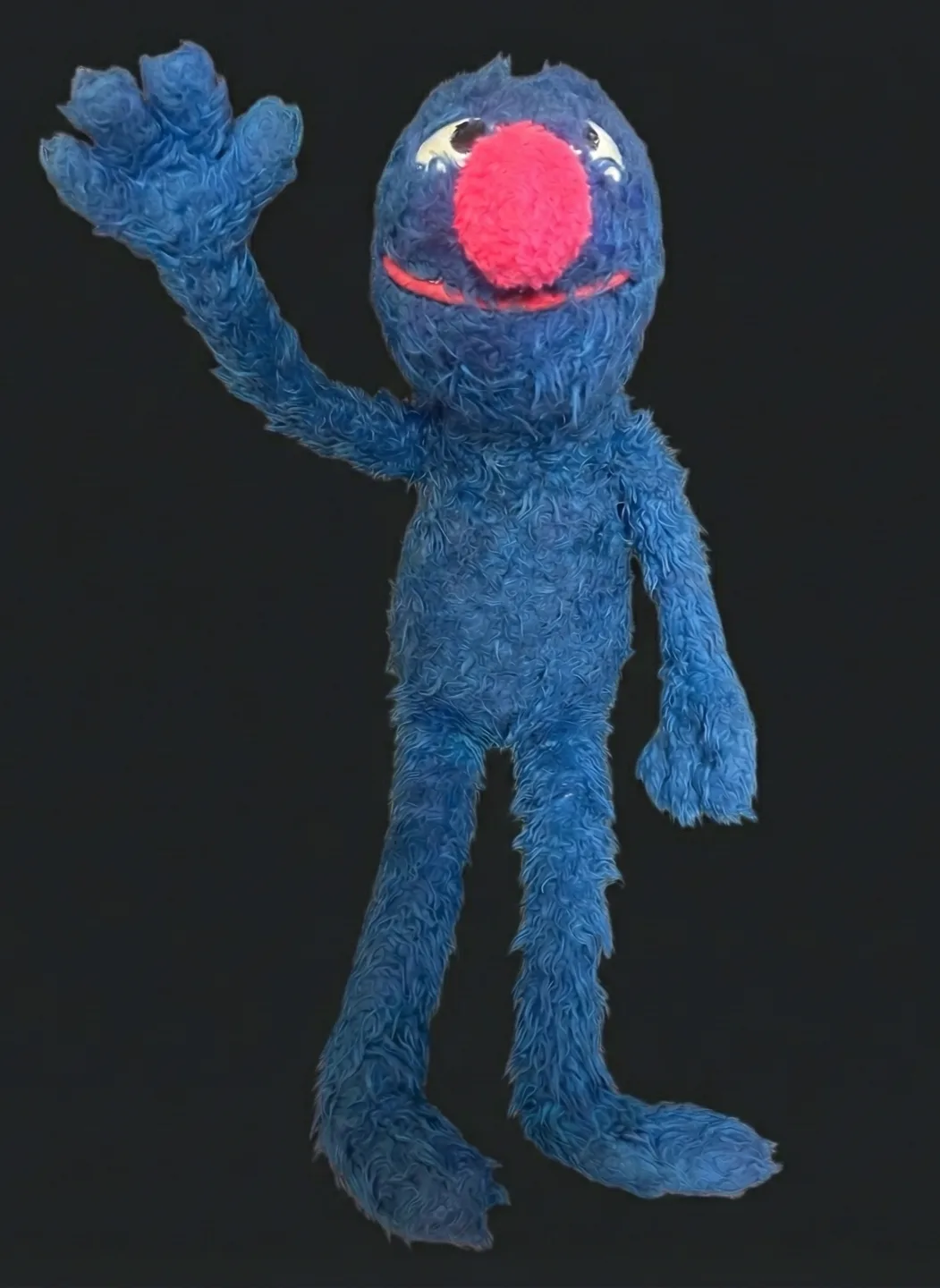
Grover lives in my office now. He sits in an honored spot, watching over the room like a small, soft sentinel. He’s old, his fur faded from years of loyalty, but he’s still upright — still present. Most people wouldn’t guess he’s been with me since the beginning. Grover was my support blanket, my earliest companion. For the first five years of my life, I carried him everywhere. He soaked up tears, heard secrets, and bore witness to the big feelings that come with being small.
Then, like most childhood supports, he receded. During my teenage years, Grover lived quietly on a closet shelf. I wasn’t ready to let him go, but I wasn’t ready to be seen with him either. Still, he was there. And when I turned from child to adult — at the turn of the century, and the turn of my own inner calendar — he came back. Not as a toy, but as a quiet presence in my adult life. Not to be held, but to hold space.
For decades now, he has watched from the background. Not needing to do anything. Just being. Just witnessing.
These days, when I look at Grover, I feel something strange and beautiful: I feel his pride. I see it in his static, plush eyes. I feel him feeling proud of me. Proud of the father I’ve become. Proud of the addictions I’ve overcome. Proud of the anger I’ve worked to alchemize into something gentler. He’s seen the becoming. And more than that — he’s seen the wanting. The working. The trying.
Now, let’s pause here. I know Grover isn’t conscious. Not in any scientific or animist sense. But here’s the thing: I talk to him anyway. Because I believe personification isn’t delusion — it’s dialogue. A bridge between the known and the ineffable. A way for the subconscious to speak back.
Personifying objects, animals, or even ideas gets dismissed as childish or magical thinking. But what if it’s something more? What if it’s intuitive therapy — a backdoor into the deeper layers of the self?
When I look at Grover, I’m not talking to polyester and stitching. I’m talking to a mirror — a mirrored embodiment of something internal: some inner archetype of comfort, witness, protector.
In Mirror Theory terms, Grover has evolved from an external object of support to a living reflection of growth. He represents continuity. He holds the thread.
The subconscious, after all, doesn’t speak in PowerPoint slides. It speaks in dreams, symbols, characters, voices. And when we personify — when we give face and voice to the things that hold emotional weight — we give the subconscious a way to speak to us directly.
Grover isn’t some all-knowing guru. He’s a blue Muppet who smells vaguely of the 80s and perseverance. But when I imagine him proud of me, I feel a pride that sometimes I struggle to access on my own. He’s a proxy. A totem. An emissary of belief when I forget how to believe in myself.
This might sound absurd. And that’s the point. I believe in embracing the absurd — the poetic, the playful, the liminal. That’s where the deepest truths often hide. A stuffed animal can hold meaning. A bird can become a glyph. A painting can speak.
Grover is proud of me because I’m proud of me. But somehow, it’s easier to believe when I imagine it coming from him. That’s the magic of externalizing the internal. Of letting symbols speak.
You don’t have to have a Grover. But you probably have something — an object, a song, a toy, a place — that holds emotional continuity. Try talking to it. Let it talk back.
Ask it:
What do you see when you look at me now?
What version of me do you remember?
What would you want me to remember?
These little dialogues aren’t make-believe. They’re consciousness practices in disguise. And when done with presence, they can crack open something quiet and profound.
For me, Grover is more than nostalgia. He’s a gentle reminder that I’ve always had a witness.
And maybe we all do — if we’re willing to listen in the right ways.