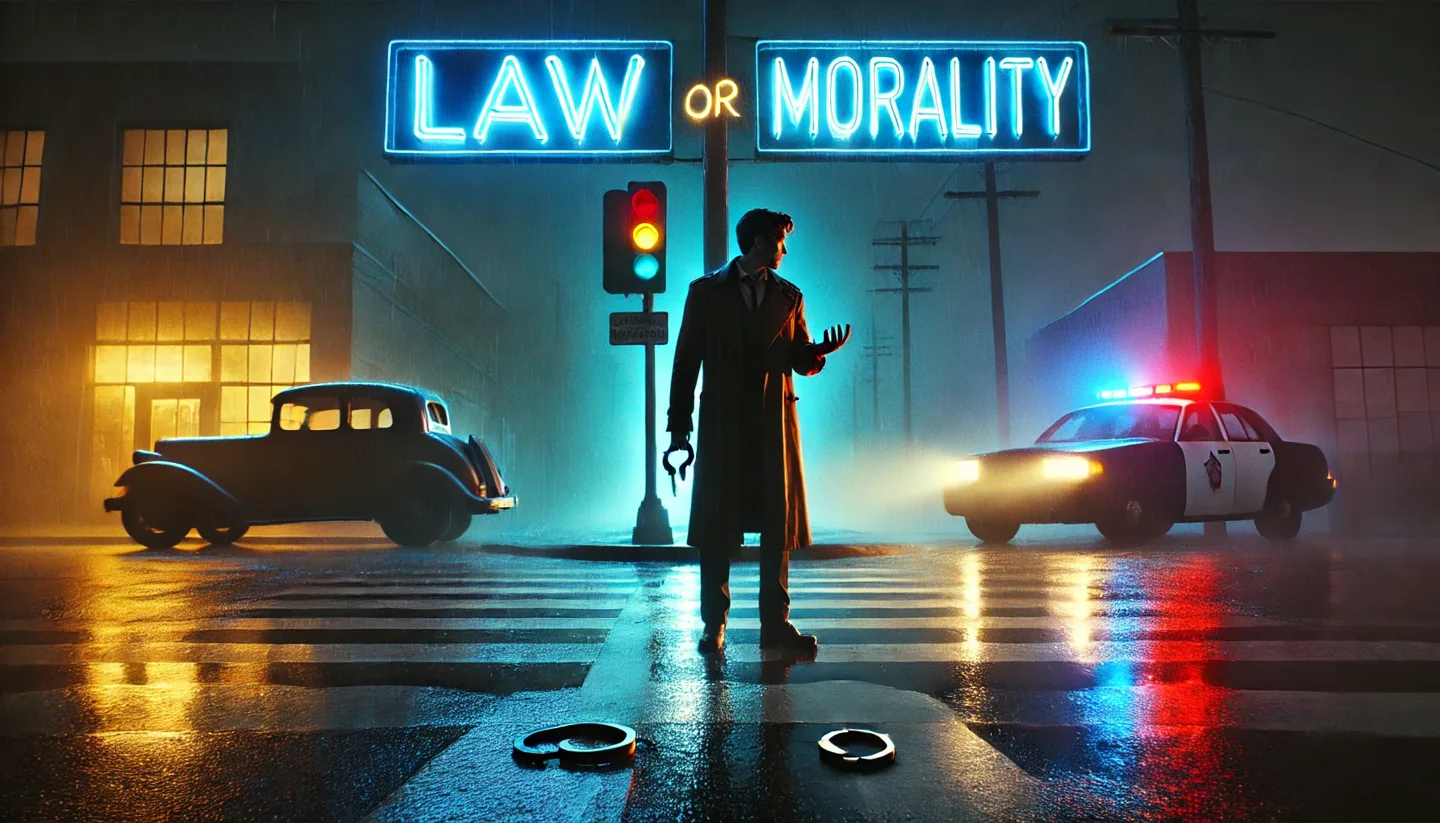
The False Equivalence of Law and Morality
Many people assume that legality equates to morality—that if something is written into law, it must be right, and if something is illegal, it must be wrong. But history tells a different story.
There was a time when slavery was legal. Segregation, child labor, forced sterilizations—all legal. Meanwhile, some of the most courageous moral acts in history—civil disobedience, underground resistance movements, acts of defiance against tyranny—were illegal.
The law is not a moral compass. It is a system of rules enforced by those in power, shaped by political interests, economic pressures, and social norms—not by what is inherently right or wrong.
So if the law doesn’t define morality, what does?
Where My Morality Comes From
I’ve always lived by a simple truth:
My morality is not based on legality.
Laws change. Systems shift. But my ethics are rooted in something deeper—in a blend of personal experience, reason, and reflection.
If I had to define my moral compass, it would be built on:
Autonomy and Awareness – Understanding the impact of my actions beyond what’s convenient or expected.
Mirror Theory – The belief that the way we treat others is a reflection of ourselves. The world is a hall of mirrors, and every action is a reflection of who we are.
Absurdist Ethics – The realization that morality isn’t written in the stars but must be chosen, even in the face of meaninglessness.
Autonomy and Awareness: The Core of Moral Responsibility
Autonomy isn’t just about acting independently—it’s about acting consciously.
True autonomy means:
Recognizing when external forces (laws, traditions, social expectations) dictate behavior without true moral justification.
Being aware of when laws reinforce power rather than justice (e.g., laws criminalizing homelessness don’t solve the problem; they just remove it from sight).
Understanding that moral responsibility doesn’t end where legal obligation does—many harmful things are legal, and many righteous acts have been illegal.
Autonomy, then, is the awareness to discern the difference between following a law because it is convenient and following it because it is right.
Mirror Theory: Morality as Reflection
Mirror Theory suggests that every action we take reflects not just on the world but back on ourselves.
If I conform to a law I know is unjust, I am reinforcing a version of myself that is willing to submit for convenience.
If I resist an unjust law, even quietly, I affirm that my morality is active, not passive.
Every ethical choice creates a feedback loop—do I want to live in a world where people do the right thing despite the law? If so, I must be willing to be one of those people.
Morality, then, is not a list of rules to follow. It is a mirror we hold up to ourselves every day.
Absurdist Ethics: Choosing Morality in an Uncaring Universe
In a meaningless universe, there are two options:
Passively accept imposed morality (law, tradition, religion).
Actively construct meaning and ethics based on reason and lived experience.
I choose the latter. Absurdist ethics doesn’t mean rejecting morality—it means owning it.
It means acknowledging that no higher force is dictating right from wrong.
It means accepting the weight of ethical choice—because there is no cosmic referee keeping score.
It means recognizing that law is an agreement, not a moral absolute—and agreements must be constantly questioned and re-evaluated.
Addressing the Counterargument: Isn’t the Law Just Collective Moral Wisdom?
Some may argue:
“Laws aren’t just arbitrary rules; they represent collective moral wisdom developed over centuries. Why should your individual morality outweigh that of society?”
It’s a fair point, but history tells us:
Laws are written by the winners of history, not by an objective moral force.
“Collective wisdom” is often just normalized oppression—women’s rights, LGBTQ+ rights, and racial justice all required resistance to legal norms before they became accepted.
Many laws are written for economic or political gain rather than moral reasons. (For instance, the criminalization of marijuana wasn’t about public health—it was about racial and political control.)
So while law can be a guide, it is never an absolute. And history suggests that those who question the law often push morality forward, while those who blindly follow it merely uphold the status quo.
Modern Examples: The Law vs. Morality Today
Whistleblowers like Edward Snowden or Chelsea Manning—exposing government corruption is often illegal, but it is arguably moral.
Criminalization of homelessness—many cities make it illegal to sleep in public, even when there are no shelters available. Is it moral to fine or imprison someone for having nowhere to go?
The War on Drugs—many nonviolent drug offenders are still in prison due to laws based on moral panic rather than harm reduction. Meanwhile, corporations profit from the same substances that were once criminalized.
Police brutality & qualified immunity—even when officers act immorally, they are often legally protected. This highlights the gap between legality and justice.
These are not abstract debates—they are everyday examples of why legality cannot be the final word on morality.
Forcing Theory: Morality as Expansion or Collapse
Forcing Theory suggests that consciousness must either expand or collapse—there is no static state. This applies to morality as well.
Ethical awareness functions the same way—if you are not actively questioning and refining your morality, you are likely defaulting to whatever the system around you has imposed.
Many people collapse into convenience—choosing to obey laws not because they are just but because it is easier.
Others expand into ethical responsibility—taking action despite legal risks, because they recognize the law does not define what is right.
Forcing Theory, then, suggests that passivity is moral decay. If you aren’t questioning why something is legal or illegal, you aren’t fully engaging in ethical life.
Final Thought: The Law is Not My Master
Laws create order, but order is not the same as justice.
I don’t reject all laws—I reject the idea that laws automatically define morality.
A just society isn’t one where people obey blindly; it’s one where they question and refine the system itself.
So if my morality ever conflicts with legality, I know where I stand.
And it won’t be with the law.