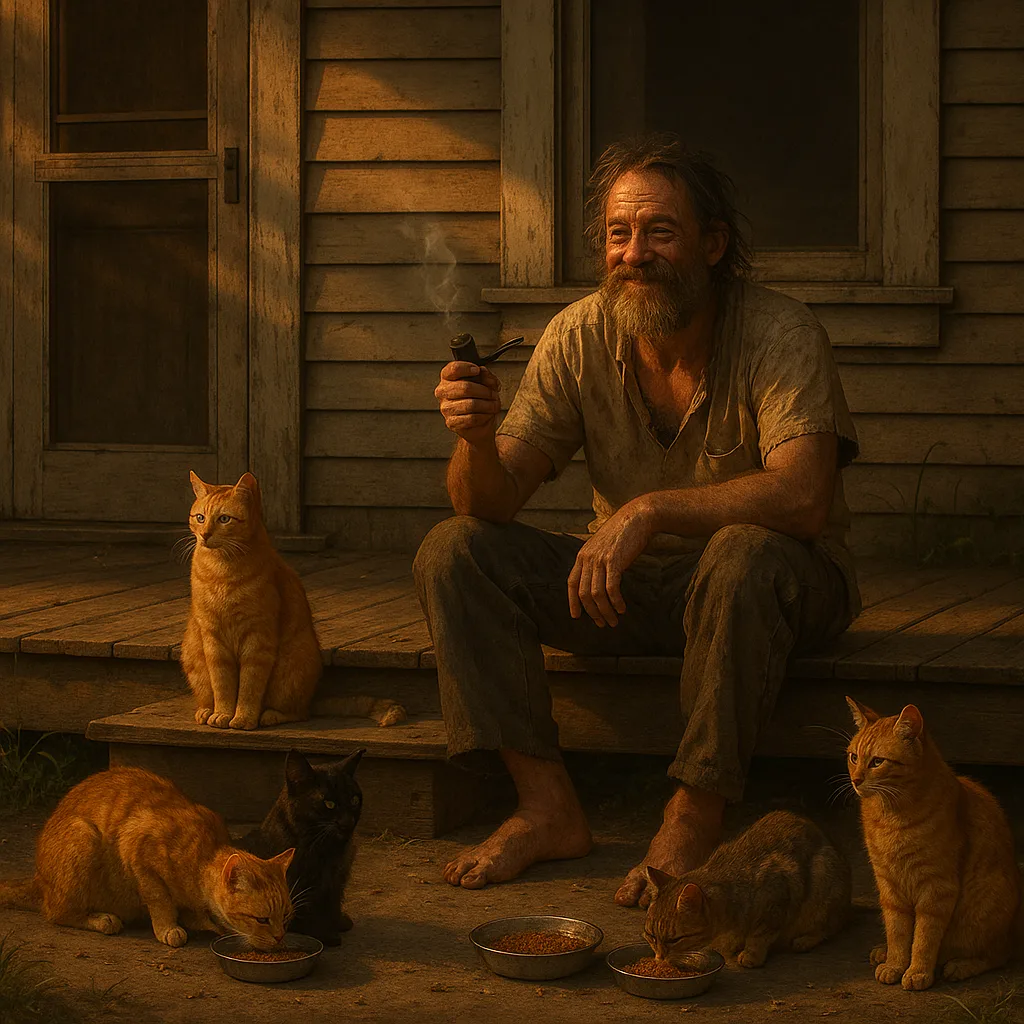
I stepped out barefoot, lighter in one hand, cat food in the other.
Three cats were already waiting. Two more watched from the fence, weighing the odds. The rule’s simple: they can all stay, as long as no one fights. Most mornings, it works. Some days, I break up a hiss-off before I’ve even sparked the bowl.
Today, they were peaceful.
I poured the kibble into two cracked bowls, lit the herb, and watched the morning stretch itself awake.
Then I noticed him.
Diogenes. Again. Sitting on the edge of the porch, cross-legged, shirtless, scratching one of the cats behind the ear like a man who was once feral himself.
“I thought I dreamt you,” I said.
“You did,” he replied. “I’m flattered. You dream very realistically.”
“Do you always show up this early?”
“Mornings are the only honest part of the day,” he said. “Everything after breakfast is propaganda.”
One of the kittens climbed onto his lap. He let it stay.
“Your cat rule is wise,” he added. “A miniature polis. Mutual survival enforced by civility.”
“I’ve got seven bowls,” I said. “But only enough food for five.”
He grinned. “Then teach them to take turns. Or starve equally. Either is fair.”
We sat there, both barefoot, quiet. The morning wasn’t demanding anything yet. Just unfolding like a tired child.
“Do you know why mornings are sacred?” he asked.
“Because they’re quiet?”
“No,” he said. “Because they haven’t remembered the lies yet.”
I laughed. He didn’t.
“Every morning,” he continued, “you get a few minutes where the world hasn’t decided what it is. If you’re lucky, you sit still and forget you’re supposed to be anybody.”
We smoked. The sun lifted. A bird landed. Diogenes barked at it.
“Still doing that?”
“Always. You moderns don’t bark enough. You tweet. It’s pathetic.”
We talked about dreams—mine, his, collective ones we weren’t sure belonged to either of us. He told me joy was rebellion, that dancing was the only honest response to entropy, and that shaving was an act of cowardice.
“Do you ever get lonely?” I asked.
“Only when I’m surrounded,” he said. “Solitude is a mirror. Crowds are static.”
I told him I missed some things. Money. Clarity. Knowing what the hell I was doing.
“Missing is fine,” he said. “Just don’t go begging for what you’ve already let go of.”
He scratched his beard, stared into the sun like it owed him something.
“You know,” he said, “you could stop pretending this porch is normal. It’s a temple.”
“A temple?”
He gestured around us. “You show up here every day. You bring gifts—beer, fire, breath. You listen. You confess. You laugh. You bark. What more do you want from religion?”
I didn’t have an answer. Not a good one.
The sun was fully up now. He stood.
“I’ll be back,” he said.
“I know.”
He turned and walked barefoot across the yard, disappearing behind the shed.
I sat there for a while, bowl empty, chest full.
The morning had remembered itself.
But I hadn’t quite yet.