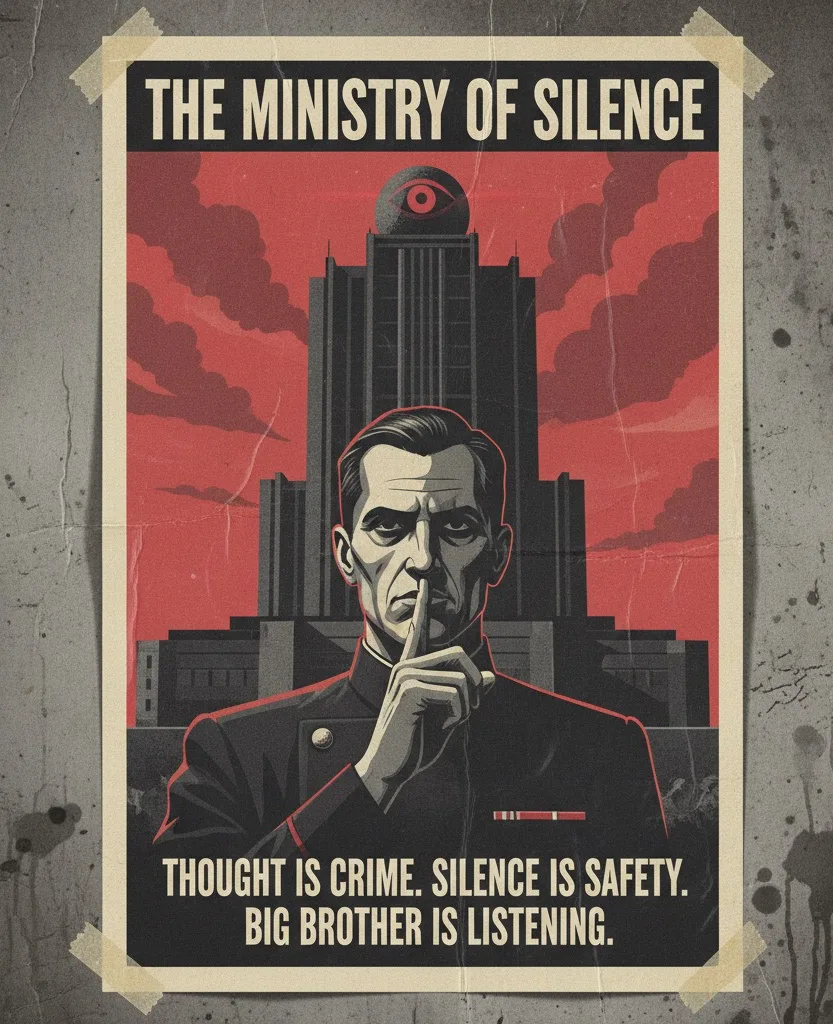
There’s an attack on free speech in America. You can feel it—not in jackboots at the door, not in Orwell’s telescreen buzzing in the corner, but in the quieter terror of your HR department and your landlord’s mortgage company. The state doesn’t need to outlaw your thoughts when your boss, your insurer, and your bank can punish them for you.
Capitalism is the perfect censor. The gun at your temple isn’t iron, it’s rent. Speak too loudly, and suddenly your “livelihood” is on the line, your kids’ insurance evaporates, your home becomes precarious. You don’t need gulags when you’ve got quarterly earnings reports.
It’s brilliant, really. A self-policing thought economy where everyone learns to muzzle themselves. You don’t agree with a gun-obsessed dolt who gets shot? Better not say it. Believe white men have written most of history in blood? Tuck that in, or the boys in khakis might come collect you in a U-Haul. Think maybe housing and healthcare should be human rights? Careful, comrade—you’ll be branded a heretic and left to rot in the cubicle gulag.
And the funniest horror is how ordinary people line up to be unpaid interns in the Ministry of Silence. Your aunt becomes a freelance Stasi agent on Facebook. Your neighbor moonlights as an ideological mall cop, measuring your lawn signs against the HOA bylaws of purity. Whole Twitter mobs volunteer as speech hall monitors—like substitute teachers drunk on power, shushing anyone who suggests pineapple belongs on pizza. Even your group chat isn’t safe: drop the wrong meme format and suddenly you’re “problematic” before brunch.
But here’s the darker punchline: people enjoy it. Policing speech scratches a primal itch. There’s a rush in catching someone else’s slip, a momentary thrill in being on the “right side” of the mob. It isn’t just fear that silences us; it’s the dopamine of watching someone else burn.
From the lens of Mirror Theory, it makes sense. What we reject most violently in others is what we refuse to face in ourselves. A society allergic to free thought is a society terrified of its own reflection. We’d rather smash the mirror than admit we don’t like the face staring back.
And so the erosion of free speech tells us less about censorship itself and more about our collective cowardice in the face of freedom. Speech is dangerous precisely because it forces us to see—the hypocrisy, the cruelty, the absurdity. Better to shut it down than endure that reflection.
But here’s the Zen Absurdist twist: we fight back not by clinging to certainty, not by shouting the loudest, but by laughing at the whole grotesque theater. By speaking anyway, even when silence is cheaper. By turning our fear into art, our gag into song. By recognizing that truth is not a possession but a process, and that every attempt to choke it only proves its necessity.
Because freedom is not comfortable. It is not safe. It is terrifying, unruly, and often absurd. That’s exactly why it matters. The courage to speak is the courage to see yourself reflected in the chaos, unfiltered, unapproved. They can take your job, your insurance, your house. They cannot take your tongue unless you give it to them.
So speak. Not because it’s profitable, not because it’s permitted—but because silence is the dullest form of death, and laughter is still free.