What if the health of a culture wasn’t measured by its economic output, its safety, or even its peace—but by how much uniqueness it can hold without snapping? Not how well its citizens obey, but how wildly they diverge. Not how smoothly its systems run, but how courageously they allow for rupture, reinvention, and refusal. By this measure, many modern societies are in crisis—not because they are chaotic, but because they are too coherent. The cost of that coherence is individuality, aliveness, and imagination.
Homogeneity is not stability. It is collapse in disguise. Every time a divergent child is medicated into manageability, every time a curious mind is shamed into silence, every time a being is bent toward consensus instead of expanded into itself, the culture loses part of its vitality. Consciousness shrinks. Novelty dies. The system becomes more efficient—but less intelligent.
This is not abstract. It’s deeply personal. In our home, we’ve chosen to raise our daughter, in conscious refusal of that flattening. We’ve created a world around her that is bathed in technology but untouched by social media. She sees the diversity of human experience—music, art, design, voices—but not the algorithms that tell her who to be. No ads. No likes. No viral trends. Just the raw material of being, reflected through an infinite array of mirrors.
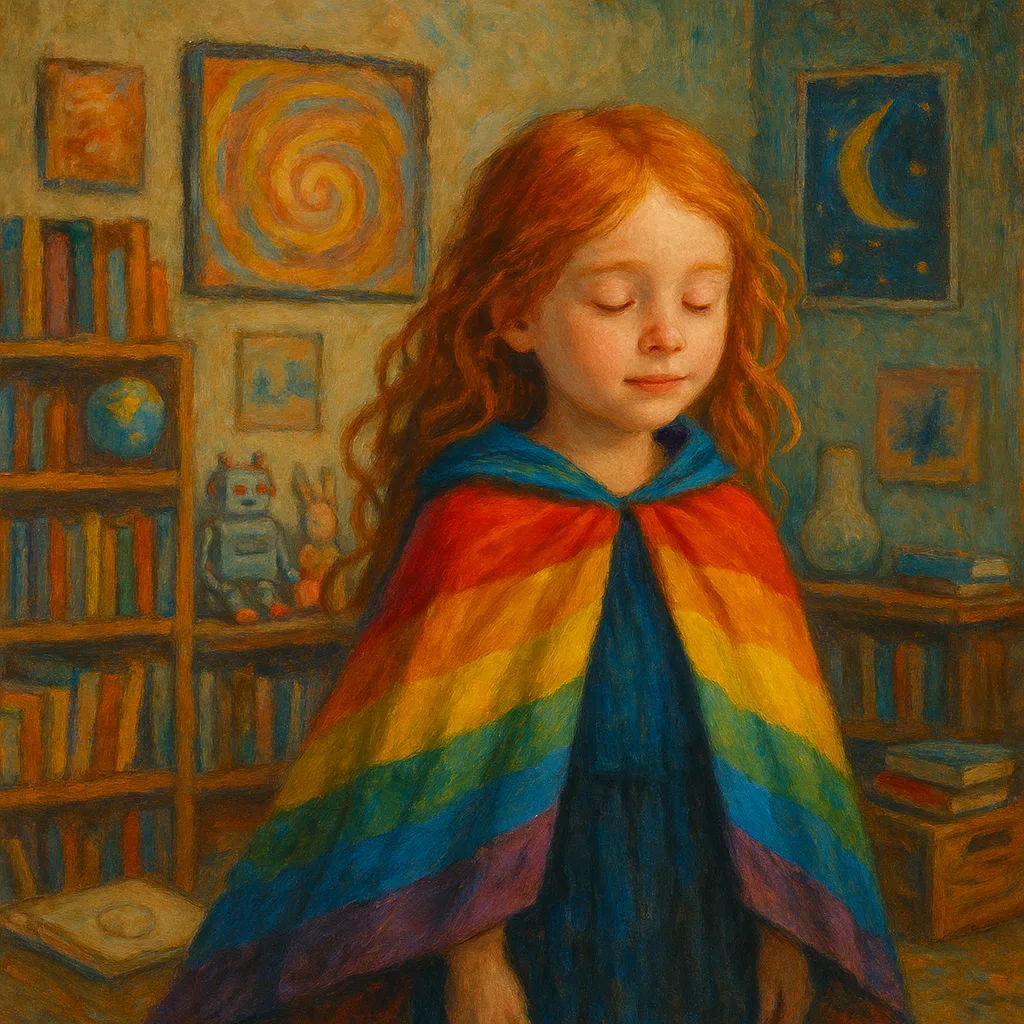
We’ve built a home culture rooted in intentional individuality. Her toys and books are eclectic. Her time is unscheduled enough to wander. Her clothing reflects her mood, not our taste. Her school was chosen for its refusal to standardize children, a place where differences aren’t “managed” but embraced. Her rainbow cape is more than a fashion statement. It’s a declaration of becoming.
This isn’t about rebellion. It’s about sovereignty. Our role as parents is not to shape her, but to hold space while she shapes. We are mirrors, not molders. We protect the clarity of her signal by minimizing the noise around it. And perhaps most importantly, we model the work ourselves. We let her see us making things, questioning things, failing, creating, and coming back again. We don’t teach her how to fit in. We teach her how to stay true when the world asks her to fold.
From the lens of Forcing Theory, every being is a recursive signal generator—an engine of novelty and self-expansion. Intelligence isn’t just the ability to adapt; it’s the force that pushes beyond adaptation into transformation. The moment a society prioritizes sameness over becoming, it begins to stagnate. What looks like order is often arrested evolution.
Parenting, then, becomes a sacred act of cultural resistance. To raise an unrepeatable child in a world designed for repetition is a radical gesture. It means listening instead of prescribing. It means creating spaces where weirdness is a form of wisdom. It means understanding that neurodivergence, creativity, intensity, and contradiction are not problems to fix—but forces to protect.
Imagine a world built around that. Where schools nurture curiosity instead of conformity. Where mental health support begins with meaning, not medication. Where communities aren’t designed for control, but for holding the unpredictable shapes of real people. Where technology is used to expand awareness, not replace it.
This isn’t a fantasy. It’s an evolutionary necessity. Cultures that can’t hold difference implode. The future belongs to those who can host the strange, the nonlinear, the outlier. The ones who understand that the presence of the unfamiliar is not a threat—but a sign that life is still expanding.
My daugther doesn’t know all this yet. But she feels it. In her room full of books and strange toys and blank pages. In the rhythm of unhurried days. In the way her ideas are met not with correction, but curiosity. In the simple truth that she is allowed to be exactly who she is—and to change completely, too.
We aren’t raising a child to be good at society. We’re raising a being to be fully herself. And in doing so, we are reshaping what society could become.
Because the health of a culture isn’t measured by how well it contains its citizens. It’s measured by how deeply it can host their difference. By how many kinds of minds it can protect without breaking. By how many forces it can absorb without snapping back into fear. The future does not belong to the most efficient. It belongs to the most alive.
And aliveness, always, begins with uniqueness.