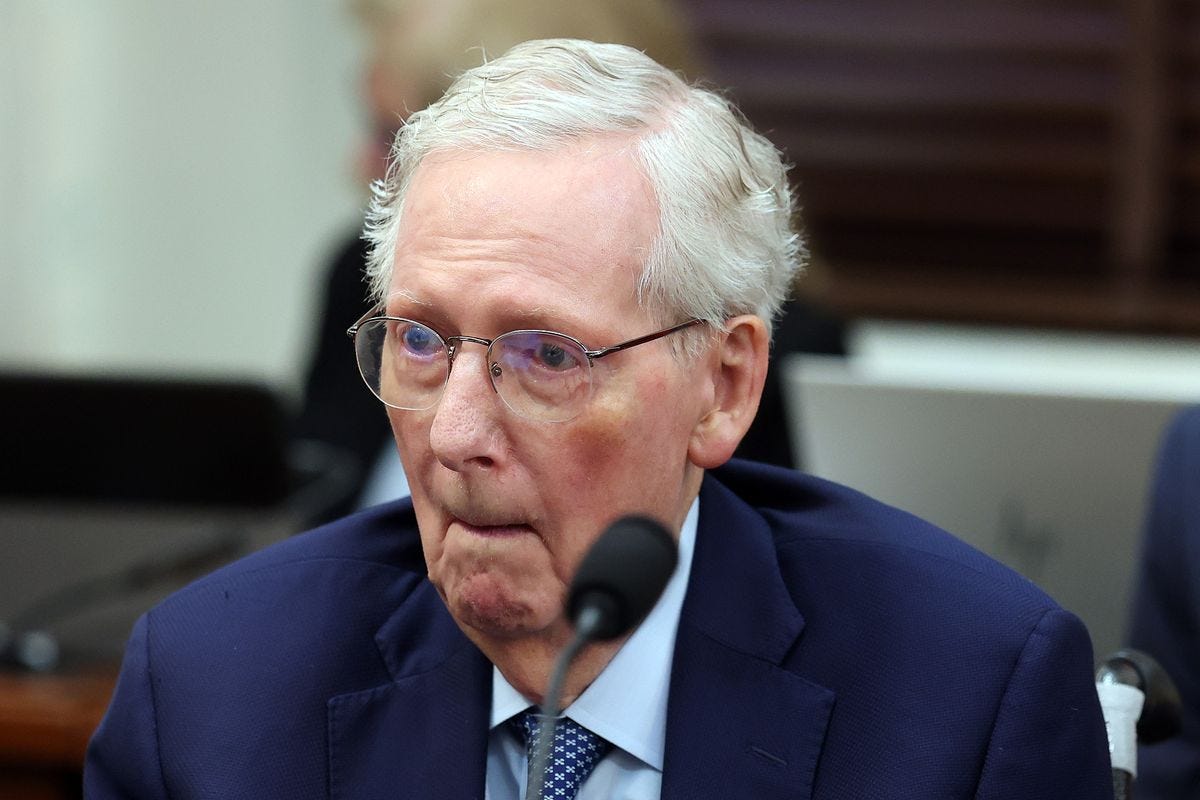
I watched the video of Mitch McConnell in the Capitol yesterday and felt sick. Not angry, amused, or vindicated. Just sad.
I disagree with Mitch McConnell on almost every political and moral question I can imagine. His decades in power have had consequences I strongly oppose, and feeling compassion for him now doesn’t erase any of that. But surely there has to be some point at which politics ends and our recognition of another human being begins.
McConnell is 84 years old. He returned to the Senate this week after being gone for roughly three months following a fall at his home in June that briefly left him unconscious, a hospitalization complicated by pneumonia, and time in a rehabilitation facility. He returned in a wheelchair, speaking slowly, and acknowledged that he is “not quite back to 100%.” He has also said that the lingering effects of childhood polio complicate his mobility. He nevertheless intends to be present for important votes as he completes his final months in office.
I don’t know Mitch McConnell’s cognitive condition. Neither does anyone diagnosing him from a short video on the internet, and I don’t need to pretend otherwise to make the point that disturbed me. What we can see is an elderly man who has suffered significant health problems, requires considerable physical assistance, and has nonetheless been brought back into one of the most powerful governing institutions in the world because there is still work to do and votes to cast.
There was something profoundly dehumanizing about watching it. Put on the suit. Get into the chair. Wheel through the hallway. Enter the committee room. Call the name. Cast the vote. Keep the machinery moving. Somewhere in that process, the person begins to look less like a human being experiencing the inevitable decline of an aging body and more like a political instrument that must remain operational for just a little longer.
Maybe nobody is forcing Mitch McConnell to do any of this. In fact, by his own account, he wants to be there. That possibility may actually make the whole thing more interesting and more disturbing, because the problem then becomes larger than one political party exploiting an elderly senator. It becomes a culture of power in which relinquishing power seems almost unimaginable.
Spend enough of your life in an institution and eventually the institution becomes part of your identity. Duty, ambition, loyalty, ego, responsibility, habit, and perhaps a sincere belief that your presence remains necessary can become impossible to separate. You stop being a person who serves in the Senate and become a senator. The office is no longer simply something you do; it is part of what you are. Under those circumstances, stepping away may feel less like retirement than disappearance.
American politics seems particularly bad at giving its powerful people permission to disappear.
We speak endlessly about public service and sacrifice, yet one sacrifice we rarely celebrate is the decision to recognize that your service is complete. There is always another vote, another bill, another election, another crisis for which your experience is supposedly indispensable. The message underneath it all is difficult to miss: stay useful. Stay relevant. Stay in the room.
And so people stay.
What bothered me about the McConnell video wasn’t simply age. It certainly wasn’t the wheelchair. Disability is not incapacity, and needing physical assistance says nothing by itself about someone’s ability to think or contribute. The discomfort came from seeing severe physical frailty treated as another logistical problem for the political system to solve. If the body can still be transported into the room, apparently the machinery can continue.
That is the part that feels obscene.
There should be dignity in growing old. There should be dignity in becoming weaker, in needing help, and eventually in recognizing that the body you once commanded no longer responds the way it once did. None of those things are failures. They are what happens if we are lucky enough to live for a long time.
Yet power has a strange relationship with mortality. It encourages the fantasy that the individual remains indispensable even as the body is providing increasingly persuasive evidence to the contrary. Institutions accommodate the decline because the position matters, the vote matters, the majority matters, the next piece of legislation matters. There is always a reason to keep going.
Watching McConnell, however, the politics briefly disappeared for me. Here was a man who once possessed extraordinary political power and now needed other people to help him move through the building where he exercised it. I expected, perhaps, that some small part of me would find satisfaction in that image. I didn’t. There was no victory in it.
There was only impermanence.
That may be the uncomfortable equality waiting beneath all our political arguments. The body does not care how powerful you became. It doesn’t care how many elections you won, judges you confirmed, bills you passed or blocked, enemies you defeated, or people you disappointed. It doesn’t distinguish between Republicans and Democrats, heroes and villains, senators and the people watching them from home.
Eventually, the body says enough.
I support serious conversations about congressional term limits and age-related reforms, although both raise complicated constitutional and practical questions. But beneath those policy debates is something more fundamental that no law can manufacture: a political culture capable of accepting that relinquishing power is not the same thing as failure.
We should be able to imagine a senator saying, “I have done my part. Someone else can carry this now,” and have that decision regarded as honorable rather than as surrender. We should build institutions strong enough that no individual is indispensable and cultures humane enough that people do not feel obligated to remain in positions of enormous responsibility until their bodies make the decision for them.
That standard has to apply even to the people whose politics we despise. Maybe especially then. Compassion that only extends to people we admire isn’t much of a moral achievement.
I don’t want Mitch McConnell humiliated. I don’t want his physical decline turned into a meme or displayed as cosmic punishment for political decisions I opposed. I don’t need to believe that what I witnessed was justice.
I want him to be an old man.
I want there to be room in American life for someone who has spent decades pursuing power to finally put it down. I want our institutions to be capable of surviving the departure of even their most consequential members, and I want the people inside those institutions to know that eventually leaving is part of the job.
The Republic will survive without Mitch McConnell. It will survive without every senator currently serving, every president, every justice, every leader who has ever convinced themselves—or been convinced by those around them—that their continued presence is essential. That isn’t an insult. It is how healthy institutions are supposed to work.
Eventually, everyone should be allowed to go home.