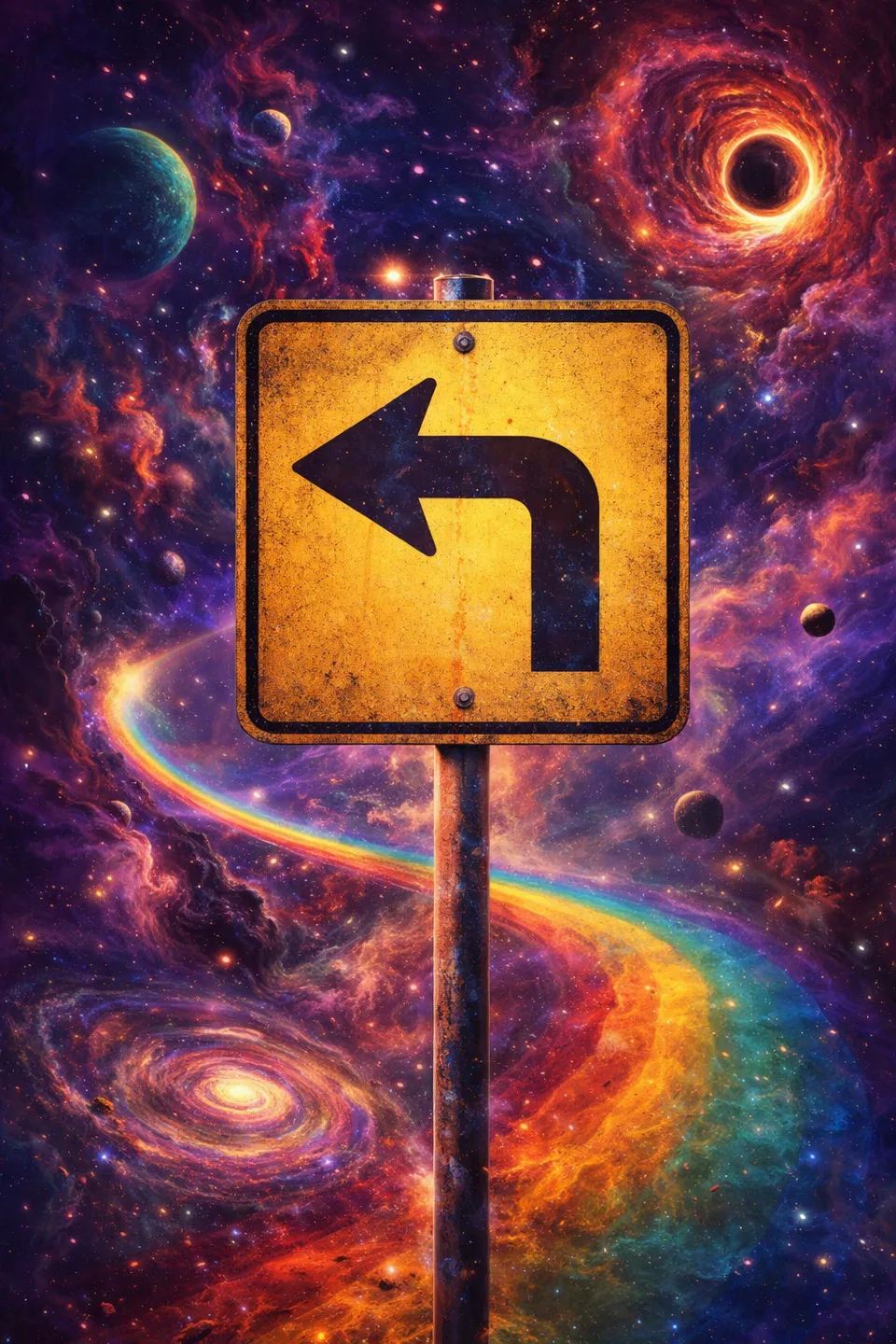
It’s been close to twenty years since I decided to go left.
You wouldn’t think choosing a direction would matter much—especially in something as mundane as walking into a store—but for me, it became a micro-ritual. In any new space, if the options are equal, I go left. Not out of rebellion, not to disrupt the flow of traffic, but because I chose it once, and then I chose it again, and then it chose me. Now, I don’t even think about it. I just go left.
It started as a way to reduce decision fatigue in unfamiliar places. Navigating crowds, scanning new environments, orienting myself—those small moments of uncertainty add up. So I built a rule. If all things are equal, I go left. Simple. Subtle. And now, automatic. But what began as a tiny behavioral shortcut became something else. It carried over into driving. Into video games. Into puzzles. I realized that in any ambiguous environment where the next move isn’t obvious, I default to the left-hand path.
This isn’t about fighting the flow. If a situation clearly calls for the right, I go right. I’m not rigid. But if there’s any doubt, left it is. And that’s where it gets interesting—because it’s made me wonder how many other unconscious rules are shaping my experience. How many tiny rituals or internal biases are making decisions before I even realize a decision is being made. What else is running on autopilot.
Through the lens of Mirror Theory, this is more than a quirk. It’s a micro-mirror—a small reflective loop where choice and identity reinforce one another. Going left is no longer just a decision; it’s a reflection of how I move through uncertainty. It’s a story I tell myself through action. Through Forcing Theory, it’s a recursive forcing function—a way to generate momentum through self-applied constraint. By reducing a decision point to a pattern, I create motion. And motion creates form. It’s not just habit. It’s architecture. And like any good structure, it offers both shelter and meaning.
The left side, symbolically, is often associated with intuition, with the non-dominant hand, with the path not taken. Maybe that’s why I chose it—because it wasn’t the default. Or maybe I chose it precisely because it was arbitrary. Either way, it’s mine now. And there’s a quiet peace in that.
I don’t plan on changing it. One day I may get a wild hair to go right from now on, and if that happens, I’ll honor it. But until then, I’m perfectly happy with left. It’s a small thing. But small things, repeated across time and space, become the hidden rituals of our lives. They shape how we move. How we see. Who we become. And sometimes, all it takes to see yourself a little more clearly is noticing which way you tend to turn when no one’s watching.