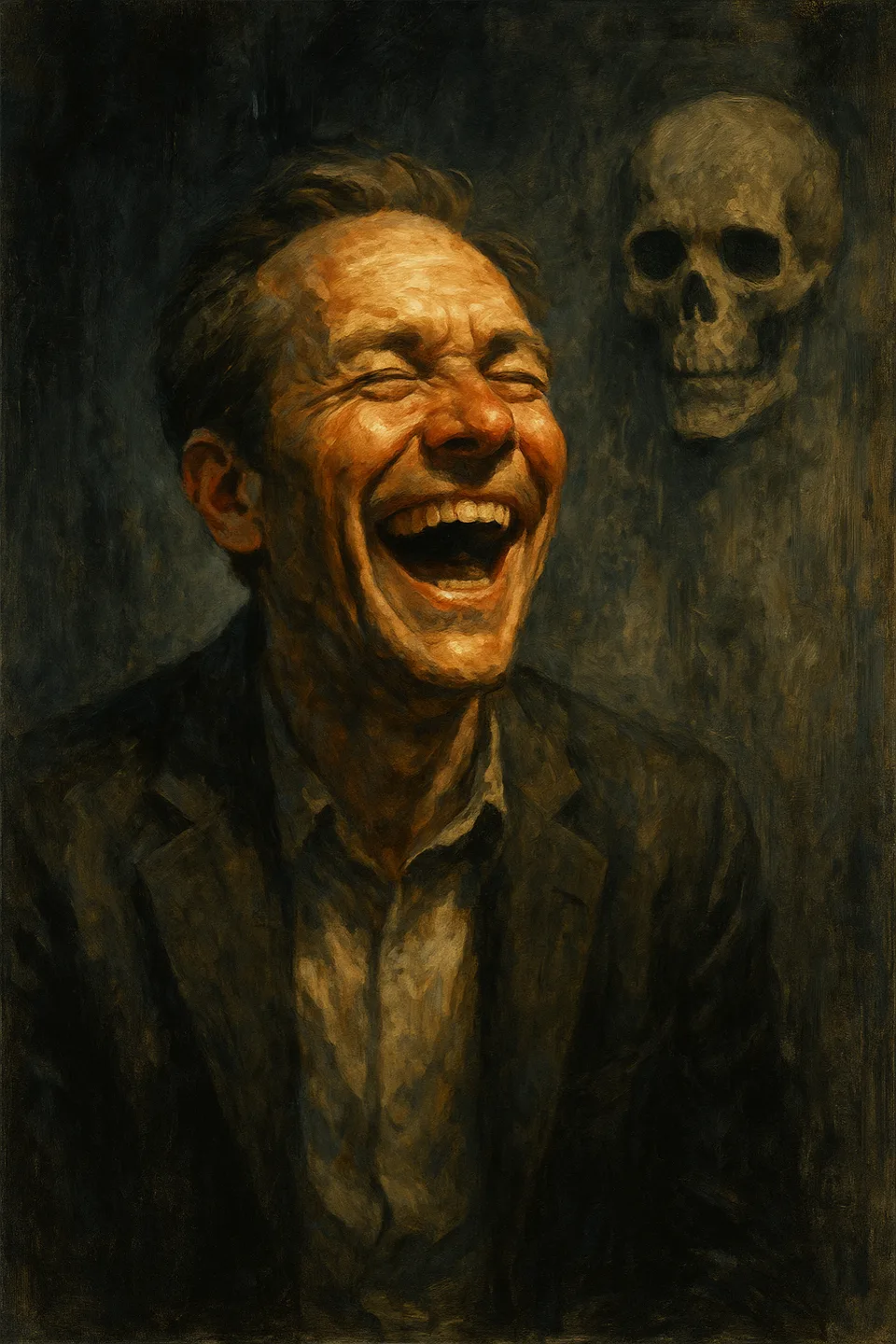
Somewhere between fascism’s rally cry and capitalism’s terms of service, someone starts laughing—and that sound, absurd and holy, is the last honest noise left in the room. It doesn’t belong there. It ruptures decorum. It makes people uncomfortable. But there it is, vibrating like a tuning fork for the unsanitized parts of the soul. I laugh too. I always have. At the worst possible moments. In hospital rooms, at funerals, during corporate training videos. I’m not proud of it—but I’m not ashamed either. Laughter, for me, is survival. It’s the pressure valve on a collapsing ontology—truth leaking out as laughter. It’s the body’s last act of rebellion before it folds into despair.
There’s something sacred about that reflex, how unprogrammed and involuntary it is. In a world that would algorithm every aspect of human behavior—how you work, how you love, how you grieve—laughter is one of the last things they can’t quite pin down. You can fake a smile. You can automate a headline. But a laugh that erupts unbidden? That’s spirit. That’s glitch-in-the-machine energy. It’s Diogenes barking at Alexander the Great. It’s a frog with a cardboard sign mocking a billionaire. It’s a Dadaist poem read aloud to armed guards. It’s Camus whispering, “Should I kill myself or have a cup of coffee?” and deciding, absurdly, on espresso.
Laughter doesn’t ignore the horror. It names it. Then it exaggerates it into something grotesque and undeniable. It turns the emperor’s robe into a clown suit.
It doesn’t punch up or down—it punches through.
That’s why systems of power fear it. Authoritarianism requires solemnity. It needs silence. It feeds on compliance masked as decorum. But laughter breaks hypnosis. It dissolves the performative agreement. You don’t have to organize a coup. Just giggle at the wrong time and the whole ceremony starts to collapse.
This isn’t just about satire or memes or being the “funny one” in a friend group. It’s about orientation to reality. Humor—real humor—is epistemological rebellion. It says: I see the contradiction, and instead of choosing a side, I’m choosing a new axis entirely. It’s truth via distortion—a funhouse mirror that tells the truth more accurately than a polished one ever could. Every joke is a cracked koan—a doorway that doesn’t open but unhinges the wall itself.
But let’s be clear: laughter isn’t escape. It’s not always lightness. Sometimes, it’s grief in disguise. Sometimes the only thing between you and collapse is a wheeze-snort at the sheer absurdity of it all. I’ve learned to trust those moments. To see them as emotional combustion events—burning up accumulated weight in a flash of self-aware ridiculousness. Grief and joy, pain and play—none of these are separate. They churn together in the belly, and what rises up through the throat isn’t always a scream. Sometimes it’s a cackle.
This is where Mirror Theory comes in. Every laugh is a recognition. It’s the mirror cracking open. You see yourself in the absurdity. You see the gap between who you pretend to be and who you are. Between what you were told and what actually is. That moment of rupture is holy. It’s not about superiority. It’s not ridicule. It’s resonance. Even when the mirror is warped, even when it reflects back something grotesque—it still helps you see. Sometimes it’s your own hypocrisy. Sometimes it’s just your own teeth bared in the darkness.
There’s something beautiful in that. In being seen by the distortion. In recognizing yourself not in perfection, but in parody.
And then comes the force. Laughter isn’t passive. It’s not just reaction—it’s generation. That’s where Forcing Theory explodes into the room. Because every genuine laugh is a micro-awakening. A jolt of contradiction so potent it forces the mind to shift. Consciousness, if it’s anything, is a recursive pressure system. It expands or collapses. And laughter is one of its key forcing agents. It breaks pattern. It destabilizes stasis. A good laugh doesn’t soothe the mind—it rewires it.
This is why jokes that punch down feel dead. They’re not igniting anything. They’re reinforcing the known. But absurdist humor—the kind that tears through meaning while winking at it—that’s a neural Molotov cocktail. You don’t emerge the same. You’ve just been unmade and remade in a flash of ridiculous insight.
I remember learning, back when I still practiced forms of magick, that laughter was the one sound that could dissolve any ritual, scatter any conjured energy, break any spell. Not because it’s stronger—but because it’s unopposed. It has no mirror. Anger has calm. Fear has courage. Even love has indifference. But laughter? It’s sui generis. An untamed discharge of awareness so wild it can’t be bound by polarity. And even though I no longer move through life as a practicing magician, this still rings true. Laughter remains the only output without a counterpart. It is disruption. It is clearing.
So when the world feels thick with manipulation, weighted with performative virtue or tactical rage, I don’t resist with equal force—I laugh. Not to mock, but to empty the field. It’s a spellbreaker. A psychic reset. A reminder that not everything has to collapse into sides. Some things can just dissolve.
And now we’re here, in the battleground of modern humor, where everyone’s trying to taxonomize what can and can’t be laughed at. Some people want comedy to be safe. Others want it to be cruel. But both are missing the point. Humor is only sacred when it’s honest. Not safe. Not brutal. Honest. That’s the tightrope. And the only way to walk it is with both ferocity and love. The kind of humor that doesn’t just blow things up but illuminates. Not a weapon. Not a retreat. But a lantern. A flickering torch in the absurd cathedral of collapse.
So yes—I laugh. Often inappropriately. Not because I’ve given up, but because I refuse to. In a world that worships fear, laughter is prayer. It’s a spell. It’s a scream inverted. And maybe salvation doesn’t sound like choirs or trumpets at all. Maybe it sounds like a dozen people laughing at the wrong time, at the wrong place, for the right reason.
Maybe it sounds like you.