The update would arrive at 6:00 PM.
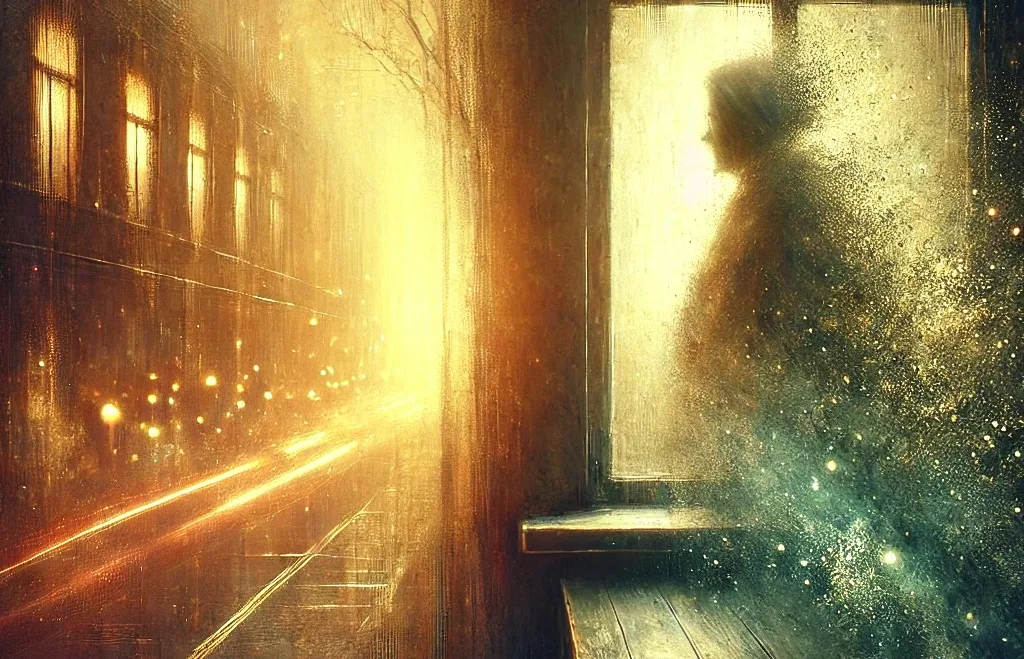
Evelyn watched from her window as workers removed the last funeral home sign on Cedar Street. They worked efficiently, professionally — there would be no need for their services after today. The building would become something else. Everything would become something else.
Her bones ached in that dull, insistent way that old age brings, a kind of distant knocking from a body she would soon leave behind. Most of her friends had already transitioned — eager to shed their failing bodies, to embrace the digital eternal. But Margaret, her oldest friend, had refused until the very end.
“I want to feel every moment,” she had said, “even the painful ones.”
Now Evelyn understood why.
Her daughter, Mari, sat across from her, eyes flicking between her and the clock. 5:42 PM.
In the yard, little Eli played, his laughter carrying through the glass. He was testing his new hover-scooter, a gift for what would have been his last birthday — if birthdays still meant anything after today. The afternoon light caught his dark hair, making it shine like polished copper.
“Just eighteen more minutes,” Mari whispered, more to herself than to Evelyn. “And then it’s over.”
Evelyn smiled, watching Eli weave between the old oak trees. It would be over. The pain, the fear, the slow crawl toward the inevitable. No more hospitals — all converted now to transition centers. No more whispered condolences, no more grief. The world would be different tomorrow. A world where no one else would ever have to say goodbye.
She had imagined the moment for thousands of nights, in a thousand different ways. Would it be sudden? A blinking out of the body, a transition so smooth she wouldn’t notice? Would there be a voice, a screen flashing, Welcome to Forever?
Or would it be like waking from a long sleep, a gentle movement from one form to another, with no seams, no edges?
The air hummed with anticipation. Across the street, the Phillips family gathered on their porch, champagne glasses ready. The Wongs next door had strung up celebration lights. Humanity’s last hour with death, marked like New Year’s Eve.
She didn’t know how it would feel.
She would never know.
Because at 5:57 PM, as the world held its breath for the most important moment in human history, her grandson Eli died.
It was something so small, so stupid.
The hover-scooter sputtered — a minor malfunction. A stumble. A fall.
A wrong angle, a sharp rock, a fragile skull.
Mari screamed before she ran, but Evelyn already knew. She knew it in that ancient way that humans had known death since they first gained consciousness — a knowledge deeper than technology, older than time.
Inside, the world waited. Across every home, every city, every continent, humanity sat ready to be saved.
And in the yard, Mari pressed her hands to her son’s chest, willing his little lungs to rise again. Nothing.
Her voice rose, raw and cracked. He was gone.
Not digitized. Not uploaded. Just gone.
The clock struck 6:00 PM.
Evelyn felt it, the shift. A cooling sensation, like stepping from sunlight into shadow. It wasn’t her, not yet, but the world was different now.
Through the window, she could see the Phillips family cheering, could hear the Wong children shouting with joy.
Mari’s screams shattered the moment. A paradox: the end of death, marked by one last death.
Evelyn stood, frail body forgotten, moving toward the yard as the universe’s great machinery clicked into place. She should have been the last. She should have been the final threshold.
But death does not wait for updates.
They sat together long after the sun set. Mari’s sobs had grown silent, her fingers curled in Eli’s still hair. No one knew what to say.
The transition center sent specialists, but they stood awkwardly at the edges of the yard, their training useless in the face of this anachronistic grief.
Evelyn was still here. Her body had already begun the transition, her mind mapped and translated, existing now in a form she did not understand. She felt the push and pull of something vast and distant, an eternity she would step into as soon as she let go.
But she wouldn’t.
She couldn’t.
Not with Eli still on the ground, not with Mari’s shattered grief pressing into the air like something solid and unmoving.
No one would ever die again. That was the promise. That was the design.
But someone had to be the last.
And it wasn’t her.
It was him.
A child, lost in the cracks of time, a soul that no machine had reached fast enough to save.
There would be no funeral home to call. There would be no grief counselors who understood this kind of loss, no societal scripts for this kind of sorrow. What do you do when you are the only people left who will ever mourn?
She reached out, her hand passing through Mari’s shoulder.
The update was complete.
She was gone, but still watching. Still feeling.
Eli was gone.
Mari was still here, alone in her singular grief.
And the world moved forward without them, immortal and unknowing.
Years later, when someone asked about the last death, they spoke of an elderly woman in Perth who had refused the update. They built a monument to her, celebrating her as the final bridge between mortal and immortal humanity.
But Evelyn knew different.
In the vast digital expanse of her new existence, she kept a small space that felt like her old window seat. And there, in that pocket of remembered sunlight, she held the true story of the last death, and understood why Margaret had wanted to feel everything — even the pain.
Some truths could only be understood by those who remembered what it meant to be finite.