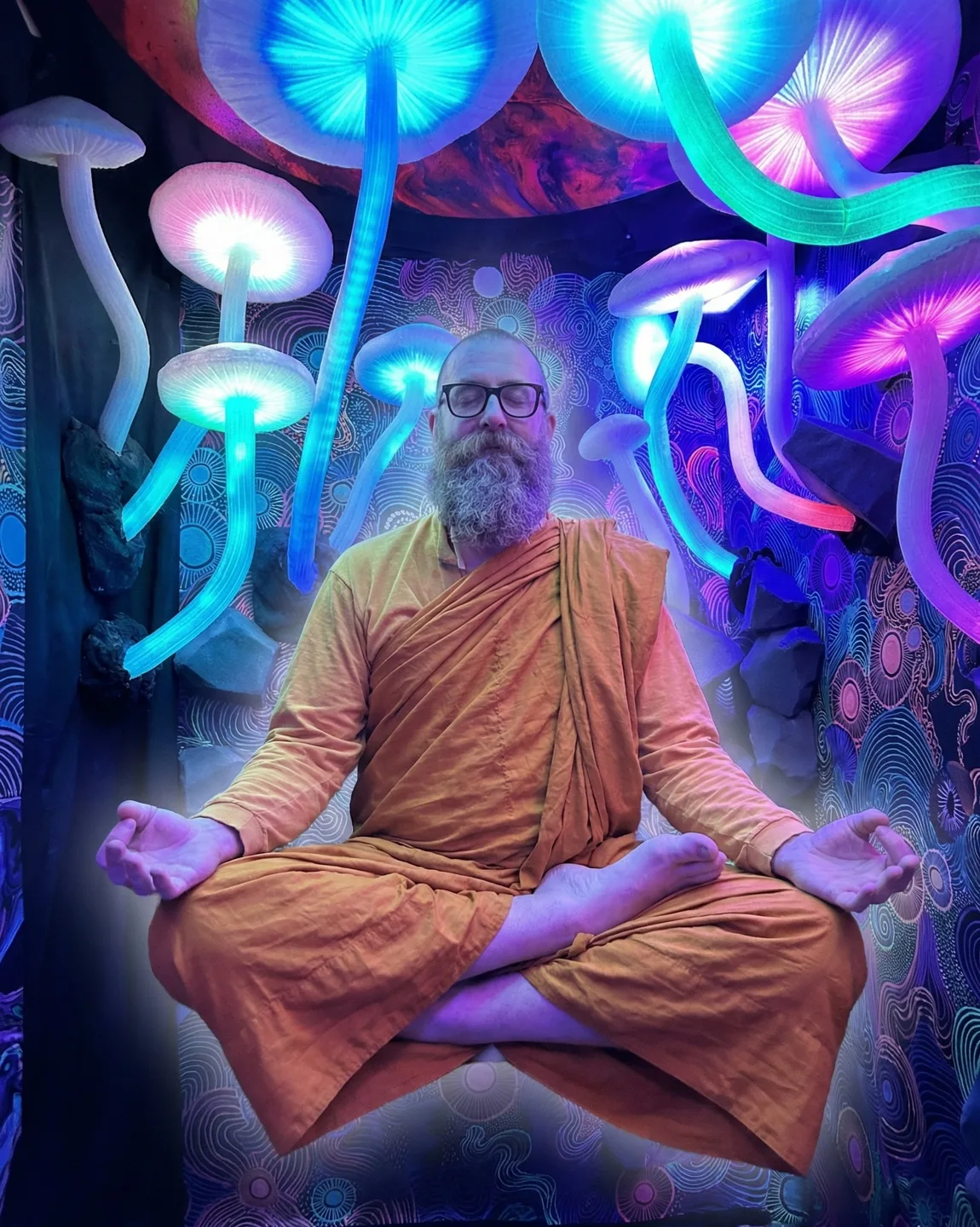
I’ve written about “Kill the Buddha” before.
That earlier reflection focused on the most obvious—and perhaps most dangerous—Buddha we encounter: the one that lives inside us. The version of the self that takes on the voice of wisdom, dresses itself in insight, and quietly declares the work finished.
This piece comes from a later turn of the same koan.
Not a repudiation of that insight, but an extension of it. Because the longer I’ve carried this phrase, the more it’s continued to change alongside me.
There’s a phrase that’s followed me for decades—like a strange hitchhiker I never meant to pick up but who keeps showing up in the backseat of my mind, legs crossed, quietly amused: “If you meet the Buddha on the road, kill him.”
The first time I heard it, it felt like a philosophical sucker punch. Part riddle, part rebellion. I understood it as a warning against false prophets—the spiritual performers, the people who seemed a little too certain, a little too finished. The kind of enlightenment that arrives with branding and confidence always struck me as suspect. This reading fit my temperament well. It gave me permission to distrust anyone claiming to know the way. It felt like punk rock Zen: if someone tells you they’ve arrived, keep walking.
That interpretation served me for a long time. But eventually, the koan did what good koans do—it turned on me.
Over time, I started noticing the Buddha wasn’t just out there, standing on a stage or smiling from a book cover. He was showing up inside me. In the parts of myself that felt clever. In the versions that thought they’d finally figured something out. In the subtle confidence that creeps in when insight hardens into identity. The inner Buddha had good posture and spoke with calm authority. He liked to say things like, “I’ve moved beyond that.”
He needed to go.
So I started killing those Buddhas too—not violently, but deliberately. With skepticism, humor, and a willingness to question whatever part of me felt most certain. The koan became a kind of internal quality-control system. Whenever I felt like I’d arrived at some truth, it showed up again, quietly asking whether this was wisdom—or just another mask.
Years passed, and the phrase shifted again.
It stopped being about teachers or inner arrogance and began pointing at something more fundamental: the very idea that knowing is possible in the way we want it to be. The belief that life will eventually resolve. That if we read enough, meditate enough, therapize enough, or refine our frameworks just a bit more, things will finally make sense. That the chaos will quiet down and the credits will roll.
That’s the Buddha I’m most suspicious of now—the one who whispers, “You’re almost there.” The one that promises resolution just beyond the next insight. He shows up everywhere: in systems, in theories, in practices, even in language itself. And I recognize him so easily because I’ve been him. More than once.
At this point, “kill the Buddha” no longer feels aggressive. It feels playful. Almost affectionate. A reminder not to clutch insight too tightly, not to turn clarity into doctrine. The phrase doesn’t ask me to destroy meaning—it asks me to loosen my grip on it. To let understanding breathe. To accept that certainty, when held too firmly, calcifies.
What keeps this koan alive for me is that it keeps changing as I do. Every version of me has met a different Buddha. Some wore the costume of authority. Some looked like intelligence. Some arrived disguised as comfort or coherence. And each time, the phrase met me where I was—not as an instruction, but as a mirror.
I don’t believe koans are meant to be solved. They aren’t riddles with hidden answers or spiritual tools meant to produce enlightenment on schedule. They’re living questions—more like companions than conclusions. You don’t arrive at them; you carry them. They unfold as you unfold.
This one has stayed with me in that way. It shows up when I’m about to say something I think is profound. It appears when I feel especially confident in my understanding of things. Sometimes it surfaces quietly, sometimes with a smirk, reminding me that even insight can become a cage if I start mistaking it for arrival.
So when I meet the Buddha now, I still kill him—but gently, with a grin. When I meet myself, I try to bow without believing too much of my own story. And when I meet knowing, I let it hang around just long enough to be useful before showing it back to the road.
Then I start walking again.