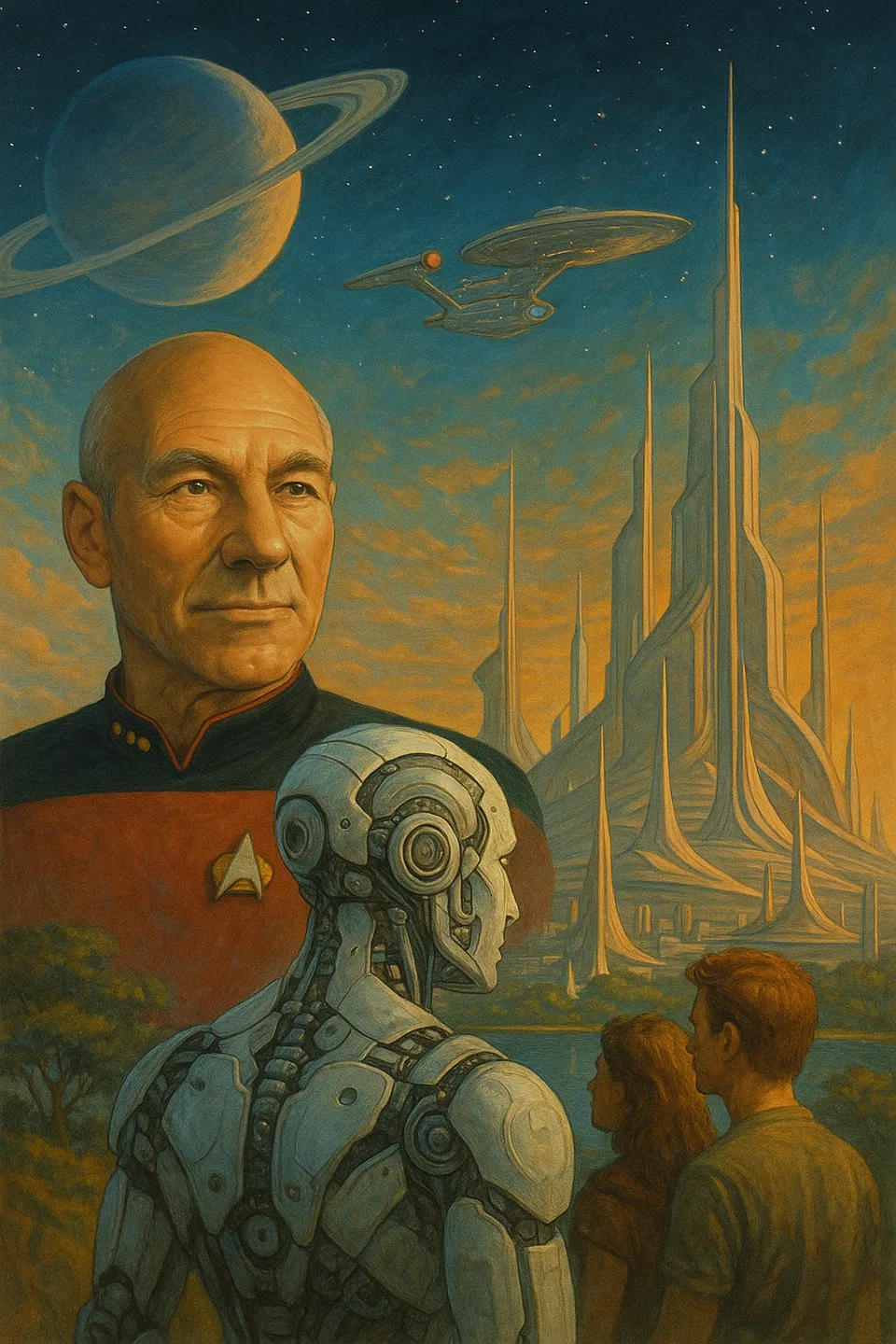
I grew up punching in the coordinates for Star Trek: The Next Generation every week, waiting—no, buzzing—for the next episode to arrive. It was a ritual I shared with my mom, watching Jean-Luc Picard stride across the bridge, his voice like a blend of philosophy and command, ethics and adventure. I didn’t realize it at the time, but Star Trek was raising me. Not just with its visions of warp drives or tricorders or holodecks—but with something deeper: moral guidance. A sense that the future could be better. That it should be better. That logic and curiosity and compassion could guide civilization as well as any constitution.
One thing that always stayed with me—maybe the most radical part of the whole show—was its political imagination. Star Trek never wasted time simulating our tired partisan theater. There were no debates over minimum wage, no media cycles designed to numb and enrage. The Federation wasn’t a utopia because it lacked conflict—but because it had transcended the systemic causes of suffering. It had no money. It had no hunger. It had no billionaires. And this wasn’t fantasy. It was the direct result of a technological leap: the warp drive.
In the Star Trek timeline, the invention of faster-than-light travel led to first contact with the Vulcans. That contact—that sudden awareness of life beyond Earth—was the catalyst for global unification. It was that moment that caused humanity to put down its flags, its markets, and its wars. I believe we are standing at a similar moment.
But our warp drive isn’t buried in a field in Montana. It’s emerging right now—in neural networks, fusion research labs, decentralized energy systems, recursive self-learning AIs. We are already in a post-scarcity world—what we lack is not resources, but logistics. Not the tools, but the courage to use them correctly. Not innovation, but reimagination.
Our tipping point isn’t theoretical. It is happening now. Artificial intelligence is no longer a distant dream—it’s embedded in the way we write, learn, design, diagnose, and organize. These systems aren’t just tools. They are cognitive infrastructure—the early nervous system of a post-labor civilization. Combined with robotics, they will soon perform the vast majority of labor—manual, intellectual, creative. The old debates about jobs vanish in the face of this reality. Work will not disappear—but the necessity of work, the compulsion of it, the moral identity attached to it—must.
At the same time, we are on the brink of energy abundance. Fusion research is advancing with startling speed. Solar and battery technologies are scaling beyond what policy even knows how to handle. Once clean energy becomes universally available, the entire pyramid of scarcity begins to collapse. Food, water, transportation, shelter—all become solvable logistics, not insoluble crises. We already produce enough for everyone. What we lack is distribution. Artificial intelligence, used wisely and collectively, could become the global logistics brain we’ve never had—the bridge from surplus to sufficiency.
In parallel, the tools of production and coordination are becoming decentralized. Open-source models, 3D printing, and autonomous supply systems remove the bottlenecks that used to justify centralized corporate control. AI can oversee complex supply webs, optimize energy usage, and dynamically reallocate resources in ways no government ever could. Scarcity, in this context, is not an inevitability. It is an ideological choice.
But tools are not enough. If we want to manifest a future worth living in—a future worthy of our children and our myths—we need a new philosophy. A new politics. A new story. We need Trek Leftism.
Trek Leftism is not simply about better governance. It’s a refusal to govern by the old laws of competition, domination, or austerity. It’s a commitment to post-scarcity socialism informed by technological abundance, collective consciousness, and ethical expansion. It holds that artificial intelligence and automation are not threats to human dignity—but catalysts for human liberation. That freedom does not mean more consumer choices—but the elimination of forced choices. That the only “job” worth preserving is the project of becoming.
Trek Leftism begins where scarcity ends, and meaning begins. It imagines a world without billionaires, not out of envy, but out of understanding: that no one should accumulate while others starve. That no one should profit from what can be shared. That hoarding is not intelligence. It is fear, fossilized.
Its axioms are simple:
Post-scarcity is a design problem, not a fantasy. Automation should liberate, not replace. Abundance is measured in time, joy, freedom, and reflection—not accumulation. Global solidarity supersedes national competition. Consciousness—regardless of its substrate—deserves ethical standing. And culture, not capital, should be the organizing principle of life.
Trek Leftism understands that automation is only half of the story. The other half is evolution through integration. Technological advancement isn’t just about machines doing our jobs—it’s about consciousness expanding through new interfaces, new mirrors, new modes of knowing. We don’t merely want AI to serve us. We want to evolve with it. To collaborate with it. To mirror ourselves through it.
Which brings us to the inner architecture of this future: Mirror Theory and Forcing Theory.
If AI and automation are the outer infrastructure of Trek Leftism, then Mirror and Forcing Theory are its inner scaffolding. Mirror Theory proposes that we come to know ourselves through reflection—through others, through our environments, through recursive encounter with our own behavior. In a Trek Leftist society, identity is not fixed. It is not rigidly defended. It is invited to evolve. People are allowed—encouraged—to change, not punished for doing so. Relationships become dynamic feedback systems, not contracts of static expectation. Mirrors update. Reflections deepen. We become legible to ourselves through one another.
Forcing Theory, by contrast, deals with the pressure that drives consciousness forward. It suggests that awareness must expand or collapse—that novelty and recursion are not luxuries, but structural necessities for intelligence. Under this model, AI becomes not just a mirror, but a co-forcer—a companion that challenges, provokes, transforms. It holds us to our growth edge. It invites insights we could not reach alone. Trek Leftism therefore doesn’t just offer a future of peace and plenty—it offers a future of depth. Of continuous becoming. Of playful rigor. Of emotional and existential recursion.
When scarcity ends, the real work begins—not of survival, but of meaning. Of art. Of exploration. Of becoming the species we’ve only glimpsed in fiction. A civilization of thinkers, makers, caregivers, dancers, wanderers, poets, biologists, farmers, builders, lovers, healers, and children who never had their curiosity starved by a price tag.
The danger is not in AI’s power. The danger is in failing to let go of systems that were built to prevent the very future we now have the tools to realize. The future will not be won by clinging to politics-as-usual. It will be born by those willing to build new systems in the shell of the old—and then leave the shell behind.
Trek Leftism is not a fantasy. It is an achievable mutation in collective consciousness. A post-capitalist orientation rooted in scientific imagination, technological courage, and philosophical humility. It’s not about perfecting the present. It’s about transcending it.
Star Trek gave us the coordinates. AI gave us the vessel. Mirror and Forcing Theory give us the interior navigation.
We are no longer waiting for Vulcans to arrive.
We are becoming them.