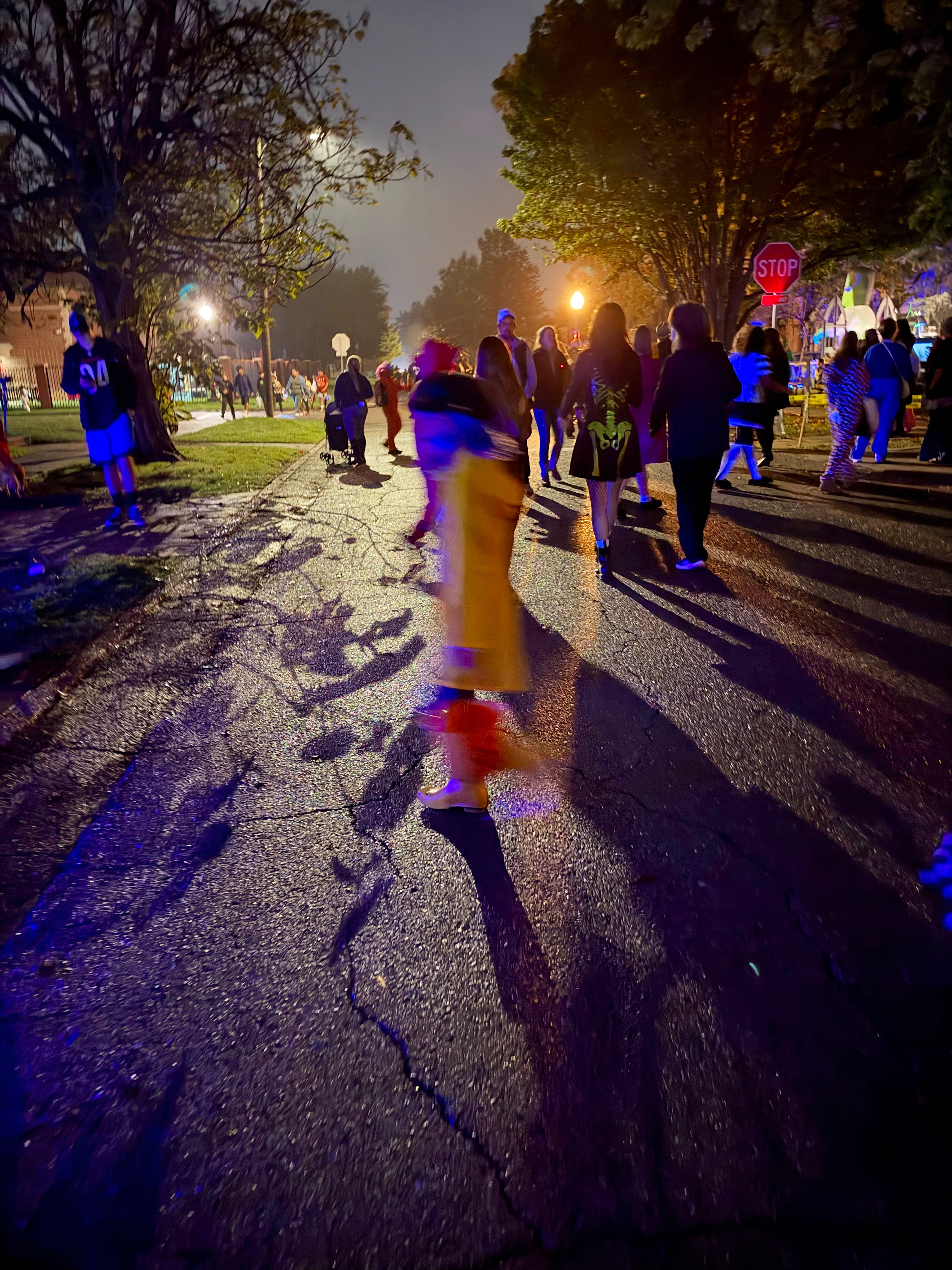
I love Halloween. I love the costumes, the decorations, the candy, and the wonderfully ridiculous idea that an entire society agrees to spend an evening pretending to be something else. I love seeing children running through the streets dressed as everything from princesses to creatures that probably shouldn’t exist outside a laboratory. And I especially love Halloween in Oklahoma City, where people seem to approach the holiday with an enthusiasm normally reserved for Christmas or college football. I’m not sure if it’s some subconscious rebellion against the religious conservatism that surrounds us, or if Oklahomans simply have an unusually strong affection for twelve-foot skeletons. Whatever the reason, I’m here for it.
When we moved back to Oklahoma from Boulder, I was surprised by just how enthusiastically Halloween was celebrated. Houses across the city transform into haunted attractions, complete with lights, graveyards, inflatable monsters, and enough plastic skeletons to suggest a serious problem with local burial practices. And it isn’t confined to the wealthy neighborhoods. From streets where families are struggling to make ends meet all the way to the manicured lawns of Nichols Hills, people decorate their homes and prepare for an invasion of tiny strangers demanding candy. Our neighborhood is particularly wonderful. The sidewalks fill with families, neighbors gather on porches, and the streets come alive in a way that feels increasingly rare. One neighbor reported handing out 2,458 pieces of candy this year. Two thousand four hundred fifty-eight! That’s not a holiday celebration. That’s a small-scale confectionery distribution operation.
After the festivities ended, Jettie Jane settled in to enjoy the spoils of her evening. Halloween is one of the few days in our house when there is no candy limit, an arrangement that I’m certain delights her and horrifies whatever tiny committee oversees responsible parenting. As I watched her work her way through a mountain of sugar, I began thinking about why I loved the holiday so much. The costumes, the children, the decorations, and the general absurdity of it all were obvious answers. But the longer I considered it, the more I realized that my favorite thing about Halloween had very little to do with Halloween itself.
For one evening every year, we collectively agree to live in a different kind of society.
Think about what we’re actually doing. We spend most of our lives protecting our homes, guarding our possessions, and teaching our children to be careful around strangers. We lock our doors and hesitate when someone knocks unexpectedly. We debate endlessly about who deserves assistance, who should provide it, and whether helping someone might somehow encourage them to ask for more. Then October 31 arrives, and we decorate our houses to attract strangers. We turn on our porch lights to announce that we have something to give. Children approach our doors with absolutely no expectation of rejection, and we greet them with handfuls of candy. Nobody asks whether they deserve it. Nobody checks their household income or demands evidence that they’ve exhausted all other candy-acquisition opportunities. There is no application, no waiting period, and no discussion of whether the child has demonstrated sufficient personal responsibility to qualify for a miniature Snickers. They simply show up, ask, and receive.
And perhaps the most remarkable part is that the people giving things away seem to enjoy it just as much as the people receiving them. My neighbor didn’t hand out 2,458 pieces of candy because anyone required it. Nobody was keeping score, and there was no expectation that those children would return the favor. The reward was participating in something larger than themselves. Each house became a small part of a community-wide agreement that, for one evening, having something to share was reason enough to share it. And the more people participated, the more wonderful the whole thing became. Generosity encouraged generosity. Trust encouraged trust. Entire neighborhoods came alive simply because people collectively decided to open their doors.
I think Halloween allows us to experience what it would be like if society itself were somebody else. Not just individuals wearing costumes, but an entire community temporarily adopting a different personality. One that assumes strangers are neighbors, that giving is a pleasure rather than a burden, and that someone approaching your door represents an opportunity rather than a threat. For a few hours, we get to inhabit a world where our first instinct is to welcome rather than question, to share rather than protect, and to participate rather than retreat. All of this happens without a law being passed, a committee being formed, or a politician taking credit for the remarkable achievement of distributing chocolate.
Of course, handing out candy isn’t the same as solving poverty, providing healthcare, or ensuring that everyone has enough to eat. A miniature peanut butter cup isn’t going to repair the world’s problems, although I suspect a few people in Washington could benefit from having one shoved into their mouths. Real generosity often requires considerably more than opening a bag of candy, and real communities face problems that cannot be solved with decorations and good intentions. But I don’t think that makes Halloween any less meaningful. In fact, I think it makes the holiday more interesting. Because for one evening, we demonstrate that the basic ingredients of a more generous society already exist. We know how to share. We know how to trust. We know how to make strangers feel welcome. We even know how to organize ourselves around these ideas without needing somebody in charge.
What fascinates me is that we don’t seem to find any of this particularly extraordinary. We participate, enjoy ourselves, and then return to our regularly scheduled lives as though nothing unusual happened. The decorations come down, the porch lights go off, and the same society that enthusiastically handed out thousands of pieces of candy resumes arguing over whether people should receive help without first proving they’ve earned it. We return to a world where generosity is often treated as an exception rather than an expectation, and where the idea of building a society around caring for one another is dismissed as hopelessly unrealistic.
But for one night, we did it. Not perfectly, not completely, and certainly not on a scale that could solve all our problems. But we did it nonetheless. We welcomed strangers. We shared what we had. We trusted our neighbors to do the same. And we created something wonderful in the process.
Which leaves me wondering whether Halloween is really the night we’re all pretending to be somebody else. Or whether it’s the other 364 days.