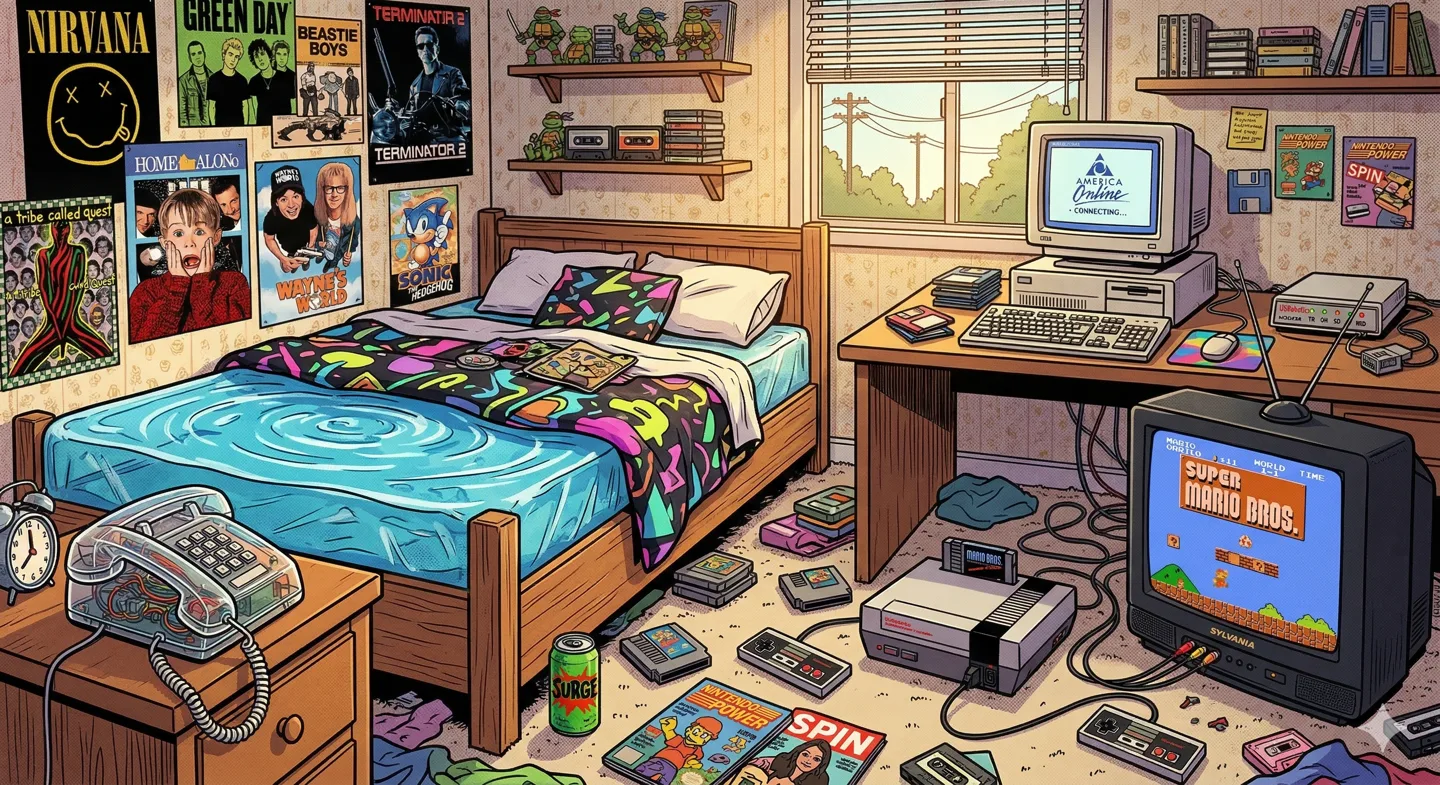
I’ve been thinking today about just how much technology has shaped my life, and honestly, it’s hard to imagine who I would have been without it. Not just what I would have done differently, but who I would have become. Technology has been with me for so long that it feels less like a set of tools and more like a lifelong companion—part teacher, part playground, part escape hatch, part co-conspirator in becoming whoever I’ve been at each stage of life.
I came up alongside a very particular arc of technological change. I wasn’t born into a world where everything was already polished, wireless, and frictionless. I remember when getting online felt like an event. I remember bulletin board systems in the late 80s and early 90s, the weird magic of dialing in, the strange intimacy of digital spaces before the modern internet became what it is now. Back then, even the limitations felt exciting. The future didn’t arrive all at once. It crackled, beeped, connected slowly, and made you work for it. Somehow, that made it feel even more alive.
I’ve loved this stuff for as long as I can remember. I played Atari 2600 and King’s Quest on the Apple IIc, and now my daughter and I play on modern gaming systems, laptops, and VR. That alone feels like a lifetime compressed into one sentence. I’ve gone from blocky little worlds built out of pixels and imagination to digital environments that try to swallow your entire sensory field. And underneath all that change, the same feeling is still there: wonder. Curiosity. The sense that technology can open a door and let you step into something larger than the room you’re sitting in.
I was the kind of person who bought 2600 magazine in the early 90s and kept reading, kept tracking, kept wanting to know what was coming next. I loved not just using technology, but understanding it, or at least circling its edges with fascination. I loved the subcultures around it: the hackers, the tinkerers, the obsessive weirdos, the people who saw machines not just as consumer products but as invitations. I felt at home in that world. I still do.
In 1995, I traded through the mail for my first cracked copy of Photoshop, which now sounds like a sentence written by a tech archeologist. Large files weren’t exactly flying around the internet back then, so naturally the solution was a slower, more analog form of piracy. Ridiculous, yes. Also kind of beautiful. And yet here I am, decades later, still creating every day with digital tools—usually GIMP now, because apparently my relationship with image software evolved into anti-subscription philosophy. The tools changed. The instinct didn’t. I’ve always wanted to make things with technology, not just consume them.
The same goes for phones. I had my first car phone installed in the early 90s, and I’ve basically carried some form of connected device with me ever since. I remember the first text I received, the first keyboard phone, the first phone with internet, the first iPhone. Each stage felt a little absurd and a little miraculous. And now I’m walking around wearing Meta glasses tied to the phone in my pocket like some middle-aged sci-fi extra who accidentally wandered off set and into real life. That would have blown my mind when I was younger. It still kind of does.
What gets me most is that technology didn’t just surround me all those years—it shaped my imagination. My dreams of the future were always entangled with it. I remember sitting there listening to a modem connect and daydreaming about what was coming next. What would the future look like? What would we build? What would become possible? And now, decades later, I log into chats with language models and do basically the same thing. Different interface, same wonder. I am still that person, just with better bandwidth and more back pain.
Technology has been many things to me over the years. It has been an escape, a refuge, a source of play, a way to learn, a way to create, a way to work, and a way to connect to people, ideas, and possibilities far outside the boundaries of wherever I happened to be. At times, it has even been a mirror—showing me not just what machines can do, but what human beings long for: connection, knowledge, expression, leverage, freedom. Sometimes distraction too, of course. Let’s not make this a religious text. But even with all its distortions and dangers, the net impact on my life has been profound and overwhelmingly positive.
And that gratitude feels especially strong right now. For all the hellscape nonsense that power structures and leaders keep trying to manufacture, I still love being alive in this era. I love having humanity’s accumulated knowledge at my fingertips. I love that I can make images, write documents, build spreadsheets, explore ideas, and collaborate with systems that would have felt like science fiction not that long ago. I love that after all these years, technology can still surprise me.
Maybe that’s part of why I feel so lucky. I didn’t just inherit a fully formed digital world. I got to witness its becoming. I got to live through the birth and evolution of modern technology in real time—from early hobbyist computing and dial-up culture to smartphones, immersive media, and now AI systems that hint at another major transformation on the horizon. That is not a small thing. It has been one of the great privileges of my life.
And now, somehow, I find myself in a position not just to watch what comes next, but to work with it, integrate it, and help shape how it enters my life and the lives of people around me. That feels meaningful. It feels like the continuation of a conversation I’ve been having with technology since I was a kid. The tools keep changing. The stakes keep changing. The possibilities keep changing. But the feeling remains familiar: curiosity, excitement, awe, and a deep instinct to lean in.
A lot of people love technology. A lot of people grew up with it. But there is something different about spending forty years traveling alongside its evolution, watching it move from niche fascination to world-defining force. When you’ve been there across the whole arc, it doesn’t just feel like innovation. It feels personal.
So today I’m just feeling thankful. Thankful that technology has been beside me for so much of my life. Thankful that I got to witness so much of this unfolding firsthand. Thankful that the future I once imagined while listening to a modem scream into the void actually arrived—stranger, messier, funnier, and more powerful than I could have predicted. And thankful that, if I’m lucky, I still get a few more decades to watch what happens next.
Some people mark their lives by relationships, jobs, or places. I can do that too. But I can also mark mine by machines, interfaces, networks, and moments of arrival: the Atari 2600, the Apple IIc, BBSs, 2600, cracked Photoshop by mail, car phones, text messages, the mobile internet, the iPhone, VR, AI. That timeline is woven into my own.
And honestly? It’s been awesome.