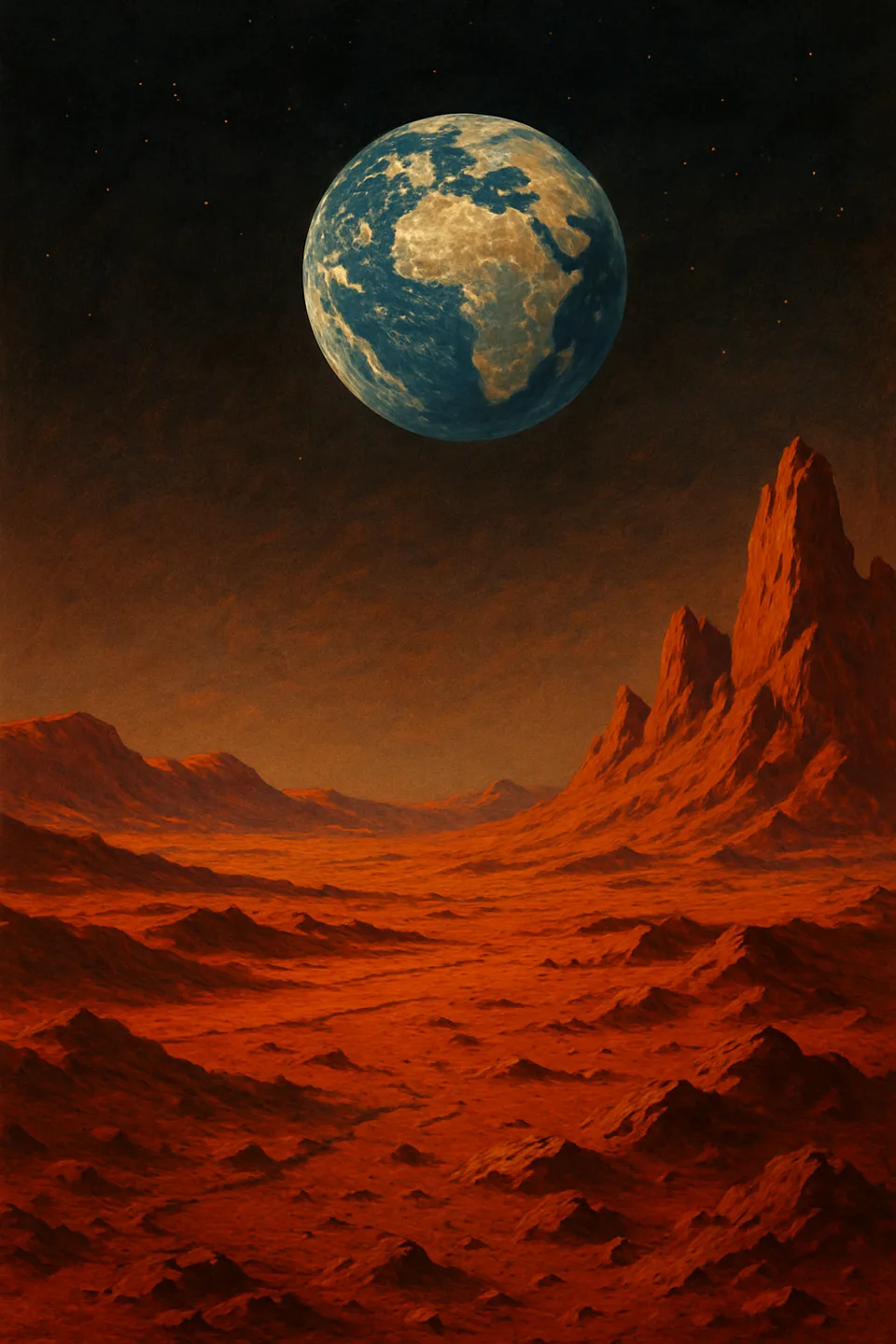
In the middle of all the noise—politics, outrage, endless arguments over who’s right and who’s wrong—something extraordinary just broke through: we may have found signs of life on Mars.
Pause there. Not headlines, not distractions, not the human circus. Just the raw, impossible fact: another world, barren and rust-red, might once have carried life. Imagine the thin sky, the dust storms sweeping across an empty desert, the silence of a frozen horizon—and beneath it all, the quiet persistence of something that once lived.
If true, it changes everything and nothing at once. Everything, because life would no longer be ours alone—it would be revealed as something the universe does, as naturally as stars burn or rivers carve stone. And nothing, because life here will still feel like what it’s always felt like: mysterious, messy, fleeting, and beautiful.
This thought pulls me toward a strange kind of hope. Because if two neighboring planets can both spark life, then the cosmos is almost certainly brimming with it—life clinging to ice moons, thriving in methane seas, blooming in chemistries stranger than imagination itself. Not as an exception but as a pattern. As inevitable as dust gathering in sunlight.
And that’s when the thought turns inward. Mars, in this way, becomes a mirror. We look across the void and see not only what was possible there, but what is true here: life insists on itself. It blooms wherever it can—in cracks, in oceans, in deserts, in rust.
And beneath that realization lies another, gentler one: what we’re seeing is not just Martian history, but our own reflection. The possibility of life elsewhere makes our existence feel less like a solitary miracle and more like a chorus—each voice rising in its own time, in its own world.
There’s something absurdly funny about this. While we argue endlessly about borders, money, and power, the universe casually reminds us: you are not alone, you have never been alone. Even here, in your backyard, life has been experimenting on more than one stage.
The reminder comes with tenderness, not scolding. To discover life beyond Earth—whether microbial or majestic—is to be told that the story is bigger than us, and that we are still at the beginning. It is to remember that wonder is always waiting just outside our door: in the stars, in the dust, in the quiet persistence of existence itself.
So yes, politics will rage on. But tonight I’m holding this other truth close: that life is not fragile rarity, but relentless possibility. That the cosmos might be filled with neighbors—tiny, immense, familiar, and utterly alien. And that in discovering them, we may discover ourselves again.