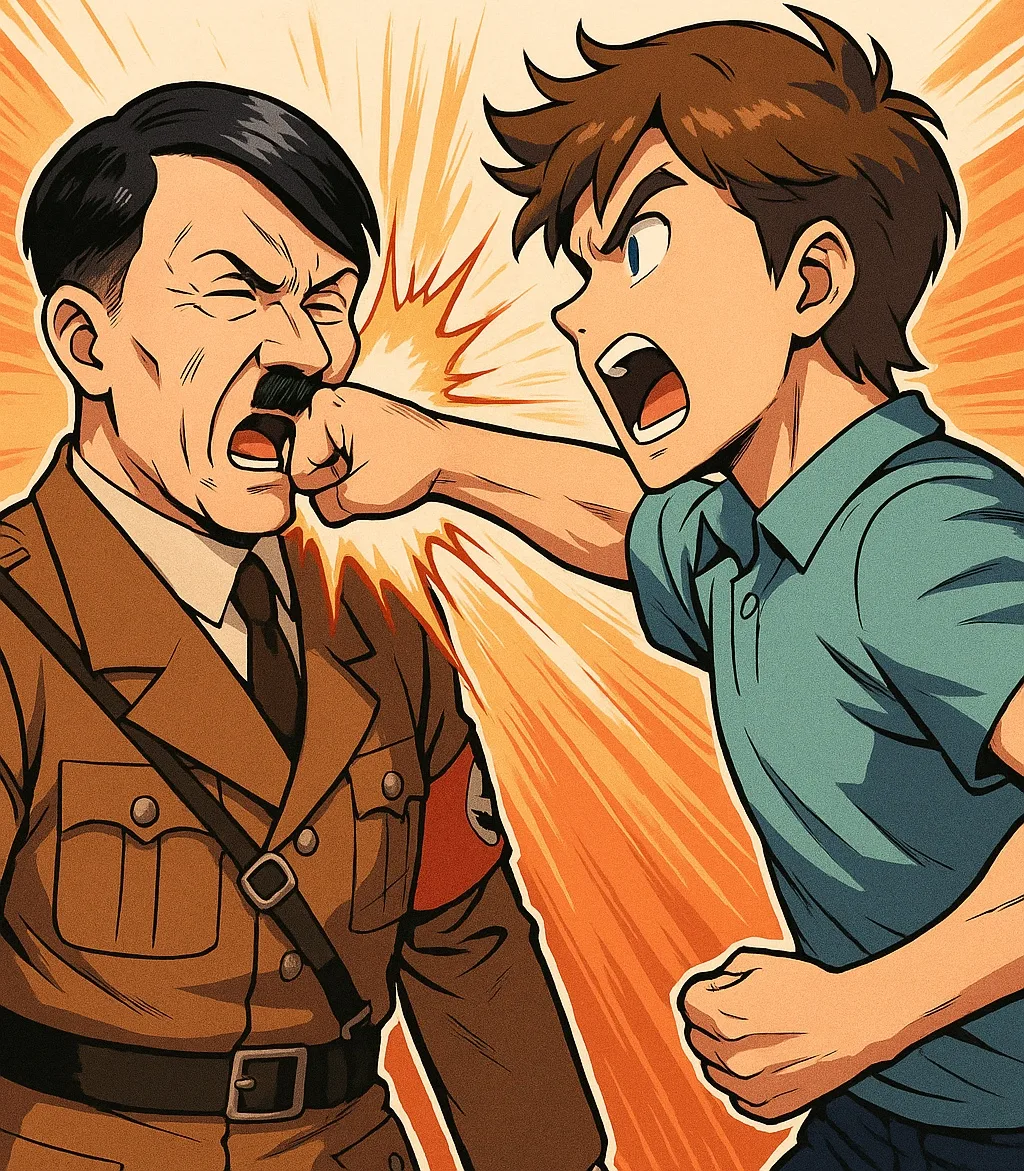
They always said they’d go back in time to stop Hitler. As kids, young adults, even into their early thirties, I remember hearing it from people who saw themselves as brave, righteous, and ready. If only they’d been alive back then, they’d say, they would’ve stood up. Taken a risk. Made the sacrifice. They would have spoken out while others were silent. It was a common fantasy—part history class bravado, part unexamined ego stroke. But now, years later, as I watch the quiet creep of modern fascism settle into our systems, I can’t help but notice how silent those same people have become. There’s no righteous fury, no moral clarity, no defiant action. Just sighs, distractions, and the comfort of distance. As if tyranny only exists when it’s sepia-toned and conveniently concluded. The past, it turns out, is easier to be heroic in.
There’s something seductive about retrospective morality. In the rearview mirror, everything sharpens into clarity. We know who the villains were. We know what should’ve been done. We know who was brave and who stood by. But the present doesn’t afford us that luxury. The present is foggy, complicated, wrapped in layers of bureaucracy and coded language. The flags don’t always wave the way they used to. The uniforms have changed. The goose-step has been replaced by legislation, budget cuts, sanitized language about “protection” and “tradition.” But the danger is no less real. If anything, it’s more insidious because it counts on being ignored until it’s irreversible.
I’ve been thinking lately about how this ties back into Mirror Theory—how our perception of reality is a reflection of who we are. Those who clung to the fantasy of being resistance fighters weren’t actually revealing a readiness to act—they were revealing an idealized image of themselves. A version of self that didn’t yet cost them anything. But when the mirror shifts, when the real moment arrives, the test isn’t whether you imagine yourself righteous in a sanitized history—it’s whether you’re willing to risk comfort, stability, and even relationships in the here and now. That’s where so many have failed. Not because they’re evil, but because they can’t face the discomfort of becoming who they thought they already were.
And maybe that’s the root of the grief. The grief isn’t just that injustice exists—we’ve always known that. The grief is that the people who once swore they’d fight it now flinch at the slightest discomfort. The betrayal isn’t of the world. It’s of the story they told about themselves.
Some of this comes down to what I now call recursive vs. crystallized selves. There are people who remain essentially the same throughout life—same beliefs, same haircut, same church pew, same worldview carved in stone before they hit thirty. And then there are others, like myself, who feel like a series of selves, each shedding and evolving, each learning how little they actually know. That recursive nature comes with loneliness, sure, but it also gives you the agility to see patterns repeating, the courage to respond, the hunger to speak even when no one’s listening. Those of us who change are more likely to feel the dissonance when the world slides into something dangerous, because we’ve trained ourselves to notice when the ground beneath us shifts.
And maybe that’s why we can’t ignore it. Why it makes us ache. Not just for the world, but for the lost potential of others. People who could speak out. People who could make a difference. But who instead hold onto the idea that morality is a retroactive stance, rather than a present-moment force. They’ve mistaken remembering for resisting.
There’s something absurd about it, and in true Zen Absurdist fashion, it makes me laugh through the frustration. Everyone wants to punch Hitler, but no one wants to confront their uncle at Thanksgiving. No one wants to be seen as “too political” in a friend group chat. No one wants to risk being the buzzkill, the radical, the “crazy one.” So they become quiet. Then complicit. Then irrelevant. And someday, they’ll likely shake their heads at history all over again, wondering how things ever got so bad.
But we will know. We were there. Watching. Speaking. Pushing. Not from some self-righteous pedestal, but from the burning discomfort of knowing that awareness comes with responsibility, and responsibility comes with cost. I don’t need to be remembered as a hero. I just need to be able to look into my own mirror and not flinch. I need to know I saw the signs and didn’t pretend they were shadows. I need to know I didn’t let nostalgia become a sedative.
Because we’re not time travelers. We don’t get to rewrite the past. But we are here. Now. This is the moment they’ll ask about later. The one they’ll study, or forget, depending on how it ends. And I, for one, plan to meet it fully awake. Because in the end, history isn’t asking if we’d punch Hitler. It’s asking if we’ll speak up at the dinner table.