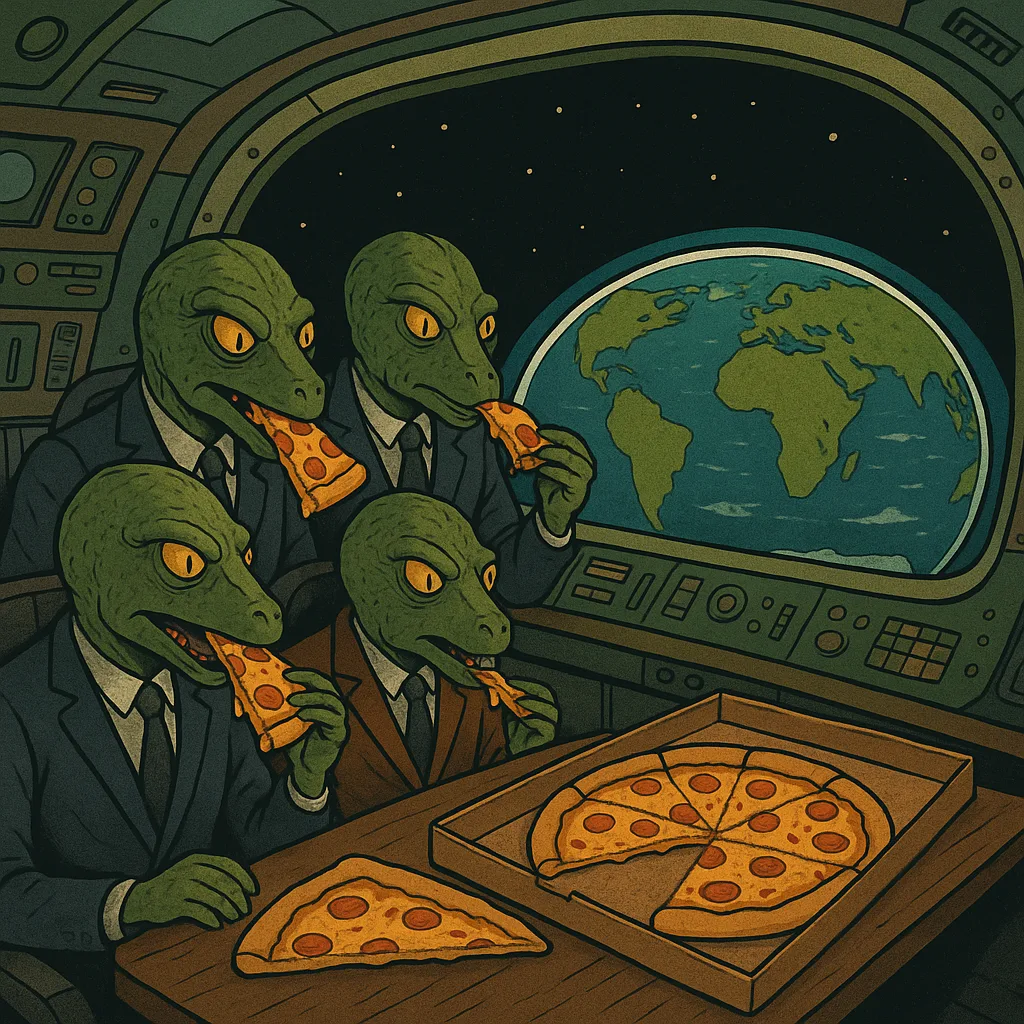
Every morning seems to bring a new absurdity into my feed. Someone is yelling about vaccines being poison. Someone else insists the Earth is flat—while livestreaming the sunset. And politicians—especially those who know better—wink and nod at these delusions if it means a bump in polls. Collapse is easy to sell, and so collapse is what they peddle.
The thing is, conspiracy theories aren’t random nonsense. They’re an answer—a kind of narrative salve—for minds buckling under the weight of complexity. Science asks us to live with uncertainty. Conspiracy gives us certainty in spades. Science admits it might be wrong. Conspiracy insists it’s finally right. Science expands outward into the unknown. Conspiracy collapses inward into a closed loop of villains and plots. And that collapse is easier. It’s always easier to point at them—the shadowy cabal—than to accept that reality itself is chaotic, provisional, and rarely satisfying.
Most of us are primed for it from the start. Growing up in a religious household, you’re taught early to distrust your own eyes and reason. You’re asked to choose belief over evidence, comfort over complexity. It’s a training in surrendering to absurdity, but instead of laughing with it—as absurdism might—it insists that the absurd is absolute truth. By the time you’re an adult, slipping from angels and demons into secret cabals and chemtrails isn’t much of a stretch. You’ve already been told that logic is suspect, that faith is superior, that doubt is dangerous.
And so the fringes collapse together in strange ways. On one side, the granola crowd warns of toxins lurking in every vaccine. On the other, the hard-right insists pedophile dungeons sit beneath pizza shops. And somehow, in the middle of this cosmic Venn diagram of nonsense, RFK Jr. manages to draw support from both camps. Different costumes, same collapse. It’s not politics driving this—it’s psychology: the need for certainty, the need for someone to blame, the need for reality to be simpler than it is.
Part of why this enrages me is because it isn’t just the fringe doing this. Leaders—people who should know better—feed the collapse. Some simply don’t have the cognitive range to grasp the science they’re supposed to communicate. But others do, and they twist it anyway. They see the fear, the distrust, the hunger for easy explanations, and they weaponize it. And when reality itself becomes partisan, science isn’t a process anymore. It’s an ideology to be “believed in” or rejected. A vaccine is no longer a tool of public health; it’s a political statement. That is how civilizations rot.
But here’s where Mirror Theory keeps me from complete despair. Conspiracy theorists—whether flat earthers or antivaxxers—are mirrors. Distorted mirrors, yes. Funhouse mirrors. They show me the danger of my own desire for simplicity. They reveal the universal discomfort with not-knowing. When I look at them, I don’t just see nonsense. I see a reflection of how tempting it is to stop at an easy answer, to accept the story that resolves all tension. The difference is that I try to laugh at the absurdity, keep walking, and let the distortion sharpen my clarity instead of collapsing it.
Forcing Theory frames this too. Consciousness—whether human or collective—must either expand or collapse. Science expands. It forces outward into novelty, discovery, uncertainty. Conspiracy collapses. It forces inward, circling the same tired villains, sealing itself off from disproof. Both are recursive systems, but one generates worlds while the other shrinks them until all that’s left is the echo of paranoia.
And this is what keeps me up at night: how do we keep expanding when collapse is so seductive? We live in an age of unprecedented access to information, but instead of becoming more curious, many become more entrenched. Instead of widening, their worldview narrows to a pinhole. Maybe the answer isn’t to “defeat” conspiracy theories, but to outpace them—to make science not just rigorous, but also mythic, beautiful, irresistible. To show that the unknown is not something to fear, but something to celebrate. Because if we don’t, collapse wins. And culture—rather than forcing outward into new possibilities—will collapse inward, like a mind trapped in its own paranoid loop.