Yesterday, I found myself crying while watching TikTok. Not misty-eyed in some dignified, cinematic way. I mean actual tears rolling down my face because some stranger on the internet had their life improved in a small but meaningful way, and apparently my nervous system has decided this is who we are now.
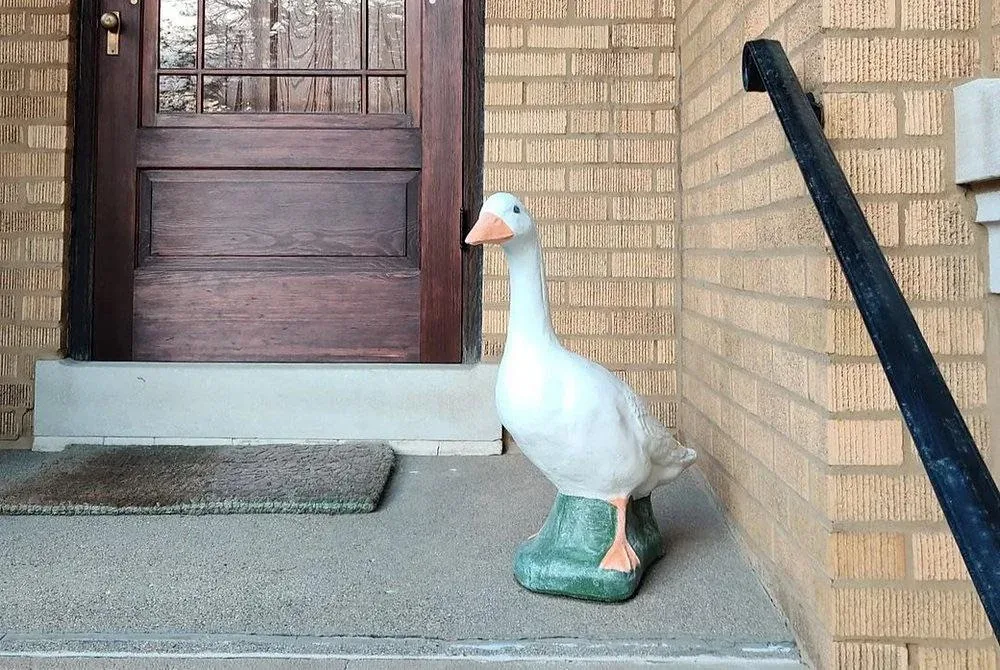
It may have been someone getting a haircut that made them feel human again. It may have been a person having their groceries paid for by a stranger. It may have been a dog who had spent far too long in a shelter finally being adopted into its forever home. It also may have been a porch goose. I wish I were joking. Actually, no—I don’t wish I were joking. That’s the best part. The comedy is part of the miracle.
There is something deeply funny about being a grown man sitting alone with a glowing rectangle in his hand, absolutely undone by a thirty-seven-second video of human decency. One part of me is fully crying. Another part of me is watching myself cry and laughing like, “Really? This is what did it? Brenda from Ohio put seasonal outfits on a cement goose, and now we are having a moment?” And somehow both reactions feel good. The tears feel good. The laughter feels good. The ridiculousness feels good.
That is the part I keep coming back to. It feels good to allow tears to roll, and it feels good to laugh at the absurdity of the moment—and of the decades I didn’t have them.
For much of my life, empathy did not come naturally to me. That’s difficult to say without sounding colder than I mean it. I wasn’t wandering around like a tiny villain in training, stroking a cat and plotting emotional distance. I cared about people. I loved people. I had attachments, loyalty, principles, and a desire to do right by those close to me. But the deep emotional resonance other people seemed to experience—the automatic ache, the immediate softness, the shared emotional weather—was not something I could easily access.
It often felt like I was observing the emotional landscape rather than inhabiting it. I could understand that something was sad. I could intellectually register that someone was hurting. I could respond appropriately, sometimes even skillfully. But there was a layer of feeling that seemed to exist behind glass. I knew the room was there. I could see people moving around inside it. I just couldn’t always get through the door.
Over the years, this part of me was described in many different ways depending on the decade, the professional, the cultural moment, and whatever diagnostic vocabulary happened to be trending at the time. Bipolar. ADD. Major depressive. Somewhere on the autistic spectrum. Neuro-spicy. Broad spectrum of awesome. Whatever label was placed on the jar, the contents remained complicated.
And before the turn of the century—which is a phrase that makes me feel like I should immediately be handed a cardigan, a Werther’s Original, and a story about dial-up internet—the mental health framing around all of this was much thinner than it is now. There wasn’t the same language for neurodivergence, masking, emotional processing differences, sensory overwhelm, or the strange ways a person can be deeply human while not performing humanity in the expected format.
So I adapted. I learned to think my way through what other people seemed to feel their way through. I built systems. I built masks. I built intelligence into armor. I became very good at reading rooms, understanding patterns, predicting reactions, and functioning well enough that people might not notice the places where I was emotionally guessing. But guessing is not the same as feeling.
The depth did not suddenly appear eighteen months ago when I came off psychiatric medication. That would be too clean a story, and life rarely offers clean stories unless someone is trying to sell you a supplement. The emotional depth had been growing for years. The pool was there. I had found my way to it before. But after removing myself from medication, the entire pool became easier to access. The fence came down. The gate stopped sticking. And now, apparently, I often just slip in.
That is the best way I can describe it. I don’t feel like I became a different person. I feel like something that was already in me became more available. Less filtered. Less distant. Less theoretical. The emotional landscape that once seemed to sit behind glass is now close enough to touch, and sometimes close enough to knock me completely over while I’m trying to drink coffee and doom-scroll like a normal American.
There is grief in realizing how much of life I didn’t feel in the moment. I can look back across my childhood and young adulthood and see the muted places: the emotional delays, the missed signals, the relationships I may have moved through with less tenderness than they deserved, the moments where someone else was reaching for a kind of emotional contact I didn’t yet know how to return. That hurts to admit.
But I also don’t want to turn younger me into a villain. He was surviving with the equipment he had. He was navigating reality through the channels available to him. He was not empty. He was not cruel. He was not broken in some simple moral sense. He was unfinished. Which, annoyingly, appears to be the human condition.
As I am today, I find it strange to look back and recognize the lack of emotional depth I experienced for so long. Not because I hate that version of myself, but because the contrast is so stark. The current version of me can be emotionally taken out by a TikTok compilation of strangers being kind to each other. The current version of me can cry at generosity, relief, transformation, and an animal finally being safe. The current version of me can feel another person’s joy in my own body.
And the current version of me can laugh while it happens. That laughter matters. Without the laughter, the tears might feel frightening or destabilizing. They might trigger the old instinct to shut the whole system down and return to the safer, cleaner distance of analysis. Without the tears, the laughter might become armor—a way to mock softness before it gets too close. But together, the tears and laughter create something else entirely. The tears are the thaw. The laughter is the witness. The crying says, “I can feel this now.” The laughter says, “And I don’t have to be consumed by it.”
That combination feels like a kind of emotional maturity I didn’t know I was missing. Not maturity in the boring, responsible, “remember to schedule your dental cleaning” sense, though I am told that also matters. I mean maturity as integration: the ability to experience tenderness without embarrassment, to be moved without immediately explaining it away, to laugh at the absurdity of being alive while still letting life touch you.
There is something almost sacred-clown about the whole thing. A man cries at a porch goose. The universe laughs. The man laughs too. The tears continue. No contradiction is found.
This is where my particular flavor of atheist Zen absurdism becomes useful. Because what else are we supposed to do with existence? We are strange animals with pattern-seeking brains and fragile bodies, carrying decades of memory and defense mechanisms, suddenly undone by a stranger buying someone a tank of gas. We live in a world capable of horror and bureaucracy and leaf blowers before 8 a.m., but also of small redemptions so sincere they sneak past our cynicism and punch us directly in the soul.
It is ridiculous. It is beautiful. It is Tuesday.
For years, I thought empathy was a trait people either had or didn’t have, like eye color, athletic ability, or the capacity to enjoy olives. Now I wonder if, for some of us, empathy is less like a fixed virtue and more like a door. A door that opens when the nervous system is ready. A door that might be blocked by fear, chemistry, trauma, masking, overwhelm, culture, confusion, or simply the strange architecture of a particular brain.
Maybe some of us are not unemotional. Maybe some of us are emotionally encrypted. And then, for reasons we may never fully understand, the code begins to break.
I don’t want to romanticize it too much. Feeling more does not magically make life easier. Sometimes it makes life much less convenient. There are days when I would prefer not to be emotionally available to the entire internet. There are moments when I think, “Could we maybe feel this at a seven instead of immediately going full Victorian widow at a train station?”
But even then, I am grateful. The tears mean something in me is alive. They mean the world can reach me. They mean joy is no longer just an idea I appreciate from a distance, but a force that moves through my chest and out through my face in the least dignified way available.
So here I am, a late-blooming emotional mess, sitting with my phone, crying and laughing at the same time. Mourning the decades I didn’t have this. Celebrating the fact that I do now. Feeling tenderness arrive in waves that are sometimes inconvenient, often excessive, and almost always accompanied by a deep internal voice saying, “Buddy, get it together.”
But I don’t really want to get it together. Not in the old way. The old way was controlled. The old way was armored. The old way could explain the room without entering it. This new way is messier, softer, funnier, and wetter, unfortunately. But I’ll take it.
I’ll take every ridiculous tear. I’ll take the porch goose. I’ll take the laughter that rises while I’m crying. I’ll take the strange grace of becoming a person who can finally be emotionally ambushed by goodness. Because if I could go back and flip a switch, I would have loved to experience my first forty years of life with the depth I’ve found in these last few. But I can’t go back. So I’ll cry now—for the videos, for the strangers, for the dogs, for the younger versions of me who couldn’t, and sometimes, because the universe has a sense of humor, for a goose in a little outfit standing proudly on someone’s porch.