I have never understood the popularity of true crime. I don’t mean that as a judgment. Murder mysteries have existed forever. Humans have always told stories about violence, death, betrayal, and the monsters hiding among us. I understand the fascination intellectually. There’s a mystery. There are clues. There’s an investigation. Sometimes there is even justice.
But the sheer amount of true crime television—and how consistently these shows seem to rise to the top—has always felt strange to me. Not wrong. Strange. I’ll scroll past yet another series about a murdered wife or a missing child or some previously unthinkable brutality and see that it is one of the most watched shows in the country. And I find myself wondering: What is everyone getting from this? Because whatever it is, I apparently don’t have the receptor for it.
So I brought the question to Aletheia.
I explained that I’m already fairly aware of the terrible things human beings do to one another. I don’t need convincing that humanity contains darkness. I think about suffering, death, consciousness, meaninglessness, violence, power, and the stranger corners of human behavior more than is probably necessary for a functioning member of society. But I have absolutely no desire to spend my evening watching the story of someone being raped or murdered. Even if they catch the guy at the end.
Aletheia suggested that true crime might provide several psychological functions simultaneously. There is danger made safe. Humans have always approached fear through stories. The thing in the woods becomes the monster around the campfire. We experience danger while remaining physically secure.
Then there is chaos converted into narrative. Real violence is messy and frequently senseless. A television show can transform it into something comprehensible. Something terrible happened. There are clues. Someone searches for the truth. The truth is uncovered. The world makes sense again. Even when justice isn’t served, the event has been transformed into a story with a beginning, middle, and end. Something incomprehensible becomes comprehensible.
I could understand all of that. But it still felt strange.
So I mentioned something else. I couldn’t even watch Game of Thrones. There was a rape scene early in the series, and I immediately noped the fuck out.
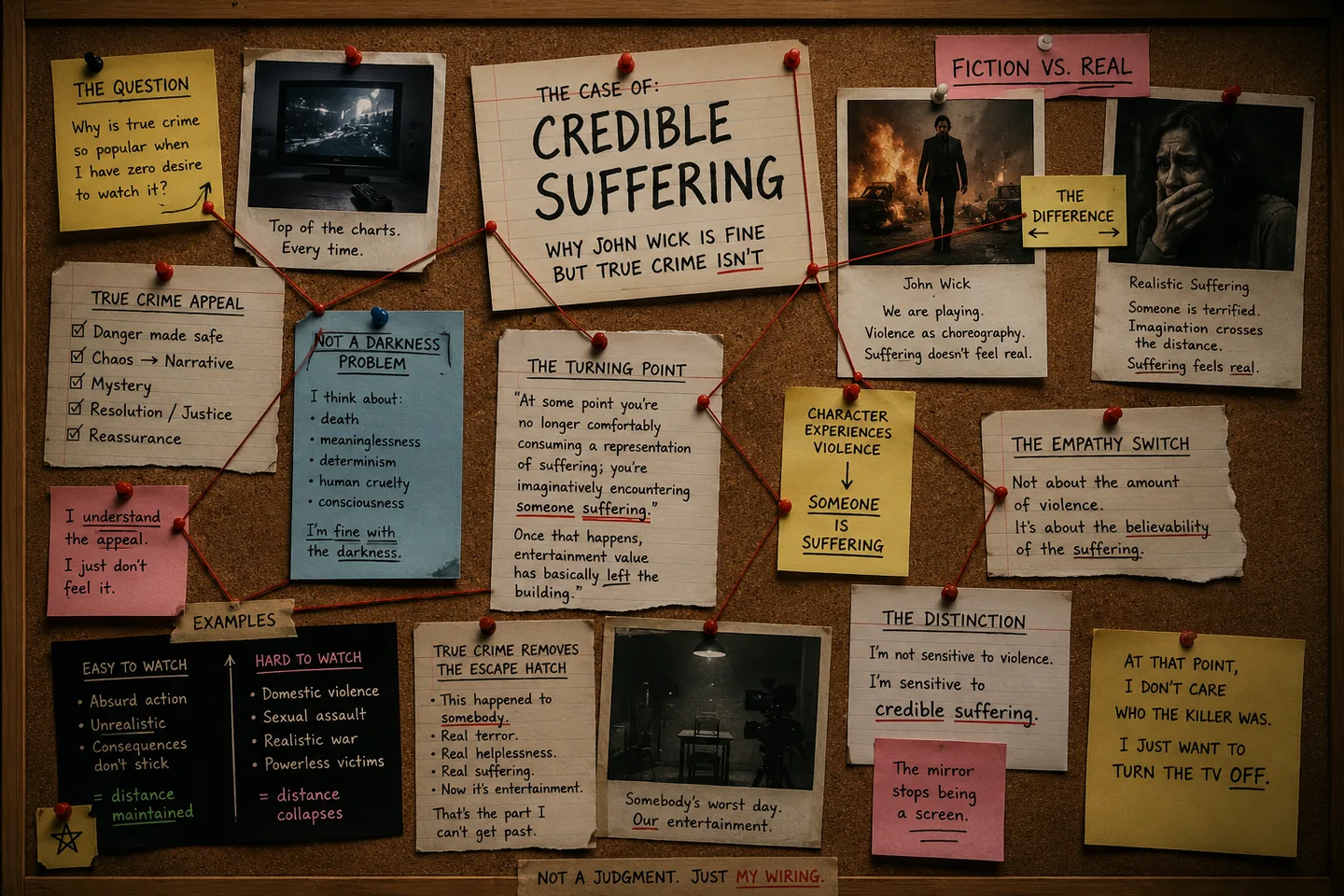
That was when Aletheia said something that stopped me: “At some point you’re no longer comfortably consuming a representation of suffering; you’re imaginatively encountering someone suffering. Once that happens, entertainment value has basically left the building.”
Oh.
There it was.
Because I don’t actually have a problem with violence in entertainment. I love plenty of ridiculous action movies. Give me some completely implausible protagonist murdering his way through eighty-seven henchmen while cars explode behind him and apparently I am perfectly capable of enjoying myself.
Which initially seems contradictory. How can I happily watch someone get launched through a plate-glass window but find a realistic portrayal of domestic violence almost unbearable?
The difference isn’t violence. It’s credible suffering.
An over-the-top action movie establishes a kind of contract with the viewer: We are playing. Bodies become choreography. Violence becomes movement. Physics becomes optional. Someone gets hit by a car, rolls across the hood, crashes onto the pavement, and thirty seconds later is sprinting down an alley. My brain understands the language. None of this is real. More importantly, the suffering doesn’t feel real.
But change the context. Put me inside a home with a frightened woman who realizes the person she loves is about to hurt her. Put me beside a soldier who is terrified and confused and desperately wants to go home. Show me someone powerless enough that they understand what is about to happen but cannot prevent it. Something changes.
The character stops being a piece of the narrative. They become a conscious being having an experience. Apparently my imagination crosses the distance. I don’t see character experiences violence. I encounter someone is suffering. Once that happens, the entire machinery of entertainment collapses.
This distinction suddenly explains a lot about my relationship with media. I don’t have an unusually low tolerance for darkness. If anything, I spend an absurd amount of time contemplating it. Death doesn’t particularly frighten me as a philosophical subject. Neither does meaninglessness. I am fascinated by determinism, consciousness, human cruelty, absurdity, power, ego, and the strange biological machinery underneath what we call the self. I don’t require a sanitized reality.
What I apparently have very little tolerance for is the aestheticization of believable suffering.
That’s different.
And it brings me back to true crime, because true crime removes even the small psychological escape hatch available in fiction. The actor in a war movie eventually gets up. The woman portraying the victim goes home. The blood washes off. But in true crime, underneath the ominous music and careful editing and cliffhanger before the commercial break, there is an unavoidable fact: this happened to somebody.
Someone experienced this. There was a moment when another conscious being was terrified. Someone desperately wanted what was happening to stop. And it didn’t. That person’s worst experience has now been transformed into narrative.
I understand that most people watching aren’t enjoying that part. They’re interested in the investigation, the psychology, the mystery, the strange behavior, the eventual revelation. Perhaps even the reassurance that terrible things can be understood and terrible people can be caught. There’s nothing inherently sinister about any of that.
But I apparently can’t maintain enough narrative distance to receive those pleasures without continually seeing the person underneath them. The mystery keeps collapsing back into the suffering.
Which makes the popularity of true crime slightly less mysterious to me while somehow making the phenomenon itself even more interesting. Because maybe what we’re really talking about isn’t people’s appetite for violence. Maybe we’re talking about different relationships with psychological distance.
Some people can encounter suffering primarily as story. Some can move fluidly between the story and the person underneath it. And some of us seem to have an empathy switch that occasionally ruins television.
This also explains something I hadn’t considered before: severity isn’t necessarily the variable that determines what affects me. An absurd cinematic decapitation might register as nothing. A realistically frightened person anticipating a slap can be unbearable. The first contains dramatically more violence. The second contains dramatically more felt experience.
Perhaps that’s the distinction I’ve been looking for. I’m not particularly sensitive to violent imagery. I’m sensitive to credible suffering. Once the suffering becomes believable enough that my imagination recognizes another conscious experience inside it, representation gives way to encounter.
The mirror stops being a screen.
And at that point, I don’t particularly care who the killer was. I just want to turn the television off.