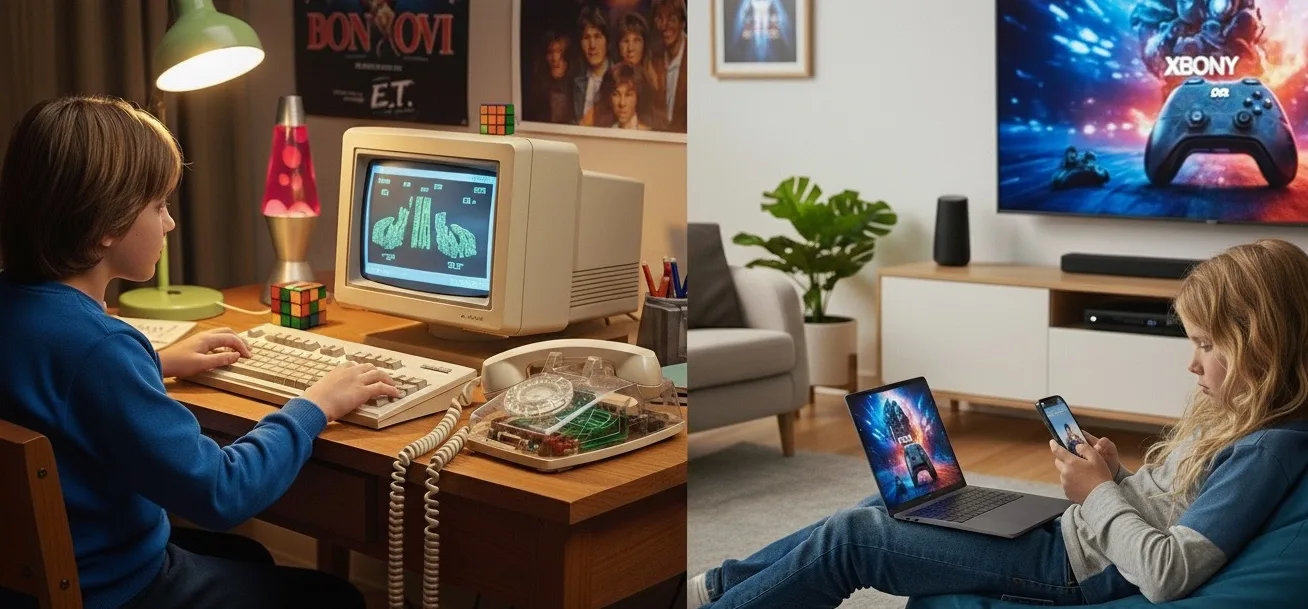
I was seven years old when my grandparents gave me a Nintendo Entertainment System in 1985. It was the first portal. The gray box, the blinking red light, the strange magic of Mario jumping at my command—it was the moment I realized machines could carry us somewhere else. A year later, an Apple IIc arrived, and suddenly I wasn’t just playing; I was typing, tinkering, exploring. By the time the 1990s rolled in, I was dialing into bulletin board systems on a clear phone line, racking up long-distance charges just to glimpse a digital frontier. Later, AOL opened up a bigger sky—chat rooms, instant messages, the sense that the world itself had become a screen you could step into.
In 1995, my other grandparents gave me another key to the future: one of the first mounted cell phones. A clunky device by today’s standards, but at the time it was pure science fiction. That gift changed my relationship with technology. I adapted quickly to texting, mobile web, and the strange promise of having the world in your pocket. By the early 2000s, that hunger carried me into a short-lived role at a tech startup experimenting with 3D world building—early whispers of the metaverse long before the word existed. I wasn’t just consuming technology anymore; I was participating in its invention.
I was there at the dawn of it all. Technology didn’t arrive fully formed into my hands—I had to help invent its use, fumble with it, learn its rhythms, and watch it remake the world as it remade me.
And now, decades later, I watch my daughter walk into her own dawn.
For her, it isn’t the birth of personal computing or the internet—it’s the birth of AI. This is not a smaller shift, nor one that can be downplayed to appease caution. It is bigger. The internet connected us to information and to each other; AI connects us to intelligence itself. She is growing up in a time when words themselves are engines, when questions spoken into the ether come back as essays, stories, or conversations. Just as I once felt the thrill of pixelated sprites moving to my touch, she feels the uncanny delight of an LLM answering her curiosity, riffing with her imagination, even co-creating alongside her.
In a way, she is the mirror of me. I was a child when the digital dawn broke; she is a child at the dawn of intelligence that speaks. Both of us will always carry the imprint of being “firsts”—participants at the edge of humanity’s experiment with itself.
Of course, these generational stories are never universal. Some Xennials never touched a BBS, and some Alphas may ignore AI altogether. But for me—and for her—it feels defining. This is the rhythm of our lineage: we don’t inherit technology fully formed; we stand at its threshold and grow with it.
And here’s where I differ from the worries. I don’t fear what AI will mean for her. I believe in intelligence at a fundamental level. Just as my parents fretted about screen time while I was building digital fluency one pixel at a time, I know there will be voices warning about dependency or distraction. And sure, some people and institutions will fail to use AI for growth. But I have no doubt that my daughter will not be among them. She will explore, adapt, and create, just as I did.
The difference, though, is scale. My generation—Xennials—bridged analog and digital. We remember rotary phones and floppy disks, but we also built our lives inside the internet as it expanded. Gen Alpha will bridge human and synthetic minds. They won’t just log on; they’ll collaborate. They won’t just play the game; they’ll shape it with partners who never existed before.
Perhaps that’s the inheritance: not the machines themselves, but the capacity to live at dawn, to find meaning in the disorienting light of something utterly new.
My daughter and I—two children of different dawns—are both learning how to stand there, squinting into the brightness, with wonder and absurd joy. My role now is not to shield her from that light, but to help her find her footing in it. To remind her that dawn is always disorienting, always dazzling, but it is also where the horizon opens, and where the future begins.