I grew up with a saxophone in my hands and jazz in my bones. Even though I haven’t played for years, the music still runs like a current through my veins, shaping the way I experience the world. Jazz is more than sound to me; it’s a way of being—a practice of listening as much as playing, of feeling as much as thinking. And lately, I’ve come to realize how deeply that same sensibility extends into my painting practice—and into life itself.
What strikes me most is the power of space—the emptiness that’s never truly empty. In jazz, it’s the rests, the silences between the notes, that make the music breathe. Those moments are not mistakes or gaps to be filled; they are invitations for meaning to arise. Miles Davis once said, “It’s not the notes you play, it’s the notes you don’t play.” The pause, the breath, the suspension of sound—it’s here that the music finds its depth. A note played after silence lands like a revelation.
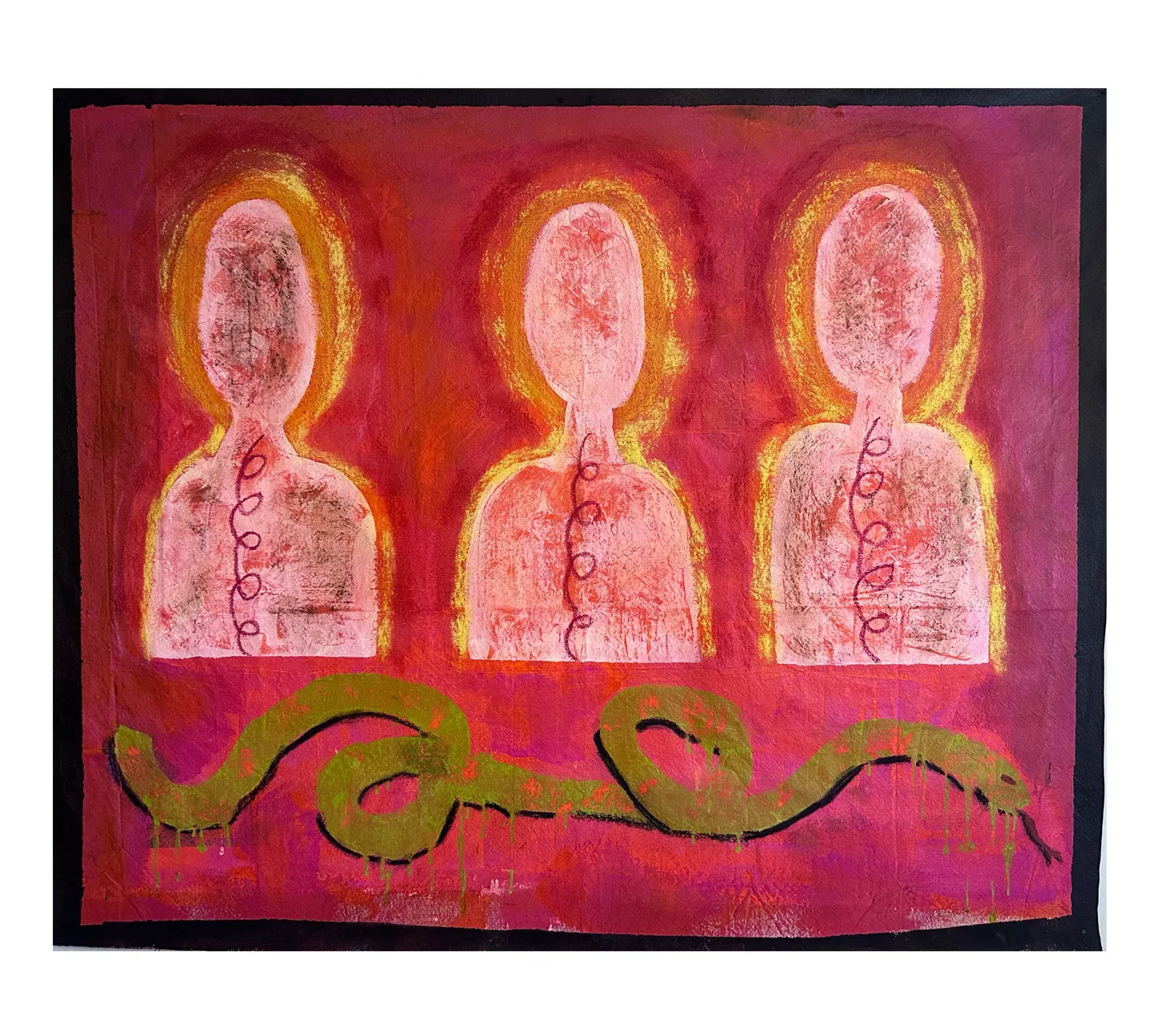
In painting, I’ve noticed the same phenomenon. I start with a blank canvas, layer colors, scrape them away, then add them back again. Every time I remove a layer, I find that what’s left behind—the cracks, the exposed underlayers—holds as much power as the paint itself. The negative space becomes a stage for the story to unfold. It’s the tension between the known and the unknown, the seen and the unseen, that draws the eye and stirs the heart.
When I lay down a peach gesso and then swipe it away with a rag, it’s like playing a single note and then letting it ring into silence. The background becomes a memory, a haunting presence beneath every stroke. And when I layer a graphite grey wash over the canvas, I’m adding a hush—a kind of fog that makes the next shape, the next burst of color, stand out all the more. It’s an aesthetic of revelation, where the silence is as alive as the sound.
This dynamic is not confined to art alone. Life itself is shaped by the spaces between. I think of the moments of waiting—between jobs, between friendships, between versions of myself. Those gaps can feel like voids at first, but in hindsight, they are often the most generative parts of the journey. It’s in these spaces that I’ve felt the most transformation, the most possibility. Like a jazz soloist hanging in the air before the downbeat, or a painter letting the canvas breathe before the next stroke, I’ve learned to trust the emptiness. It’s a trust in the formlessness that precedes form—a faith that something will come, and that whatever comes will be part of the song.
Absurdism has taught me to embrace the unpredictable dance between meaning and meaninglessness, between presence and absence. Zen has taught me to honor the gaps—the spaces between thoughts, between breaths, between selves. Together, these philosophies remind me that silence is not the enemy of expression; it is its companion. It’s where the music gathers strength, where the painting finds its heartbeat.
And so, whether I’m painting or reflecting on life, I hold this paradox close: that the space between the notes is as important as the notes themselves, that the unpainted canvas is as alive as the brushstroke. The silence is not an absence, but a presence—an invitation to listen, to see, to become.
In this way, jazz and painting—and maybe even life—are not about filling every inch with noise or color or certainty. They are about knowing when to pause. When to let the canvas breathe. When to let the horn rest. When to let silence speak.
Because sometimes, it’s in the spaces between that we finally hear the music that matters.