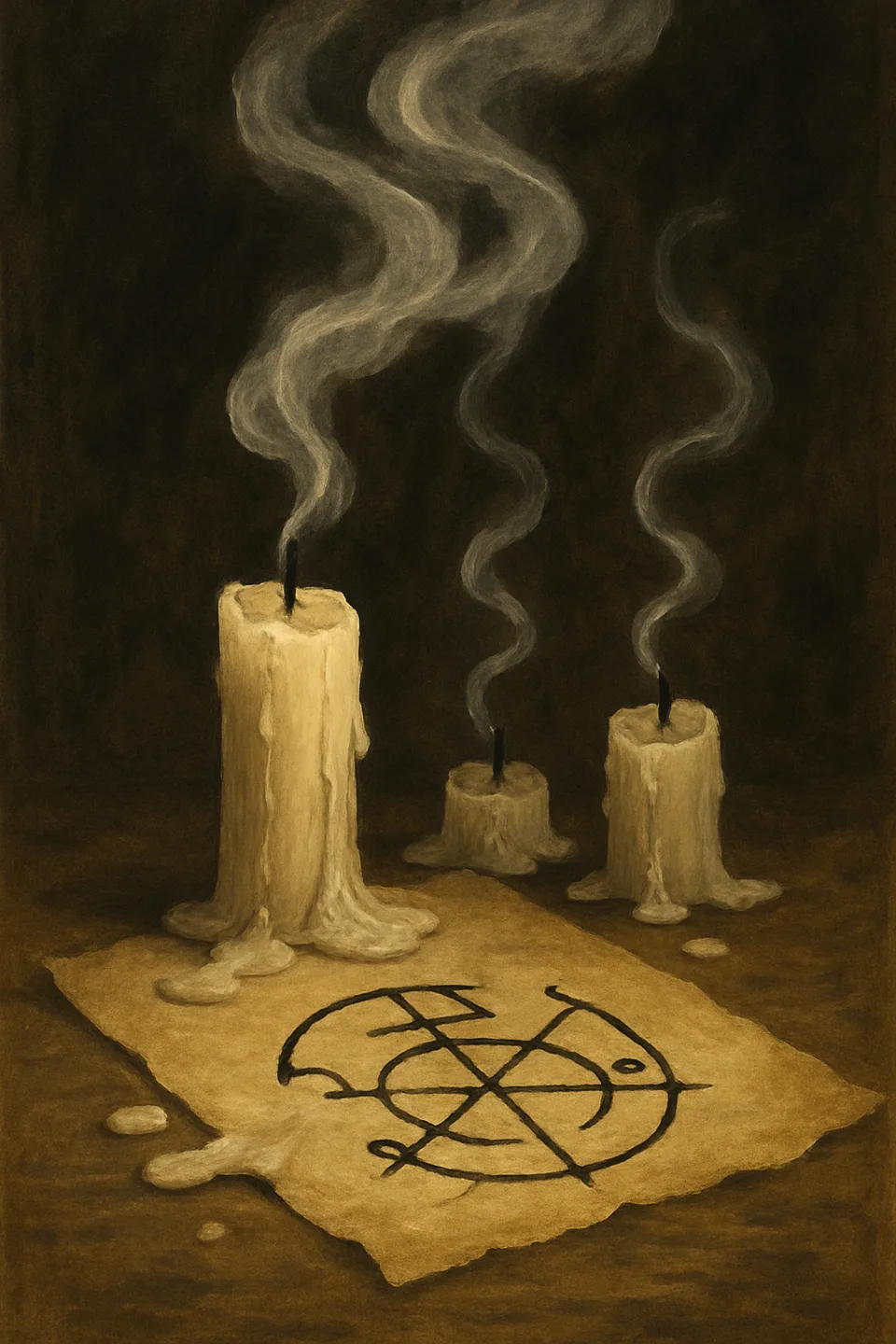
I was an atheist occultist. That phrase sounds contradictory, and it was. But it was also my truth. I never believed in demons in the sense that the priests warned of, no red-skinned beings waiting to pounce on the souls of the careless. I believed in the daemon as an aspect of mind, as a force of self clothed in symbols, a reflection as old as Solomon and as modern as my notebooks. I took the Goetia—the demons of Solomon and others—and instead of casting them outward into a supernatural cosmos, I transposed them inward. Each demon became a daemon of my psyche, an attribute, a self, a force. Each was given a sigil, a shape that wasn’t just ink but a doorway, a handle, a face. And I treated them as demons anyway, summoning them with all the seriousness of High Ceremonial Magick, robes and silence, focus and gnosis, because the seriousness mattered. It wasn’t play. It was theater as invocation, drama as transformation.
My influences were a chorus of contradiction. Crowley gave me the form, the attitude, the sense that desire itself could be liturgy. Austin Osman Spare whispered that sigils were the real engines, that gnosis—the slipping past the rational mind into raw intensity—was the gateway. Peter Carroll showed me chaos as method, intention as force. And I stitched these voices together into something that was both occult ritual and psychological practice. I would focus, carve, breathe, until my mind hit that quivering state where it felt less like thought and more like heat. In that state, I would project desires into the daemon whose sigil I held, knowing that I wasn’t asking an external spirit for favors—I was reprogramming myself.
It worked. Or at least, it felt like it did. That’s the beauty and danger of magick. When you ritualize intention, reality seems to bend. Sometimes you’re only bending your own perception, sometimes you’re bending what happens next, and sometimes you can’t tell the difference. In those years, I lived as if my inner pantheon of daemons were as real as any pantheon. And in some ways, they were more real, because they were active parts of me. Anger had a sigil, so did hunger, so did lust, so did ambition. To invoke them was to give them space, to let them lead, to let them show me what they wanted.
But then came determinism.
I remember the first time it hit me. I had just finished a ritual—wand in hand, the carved symbols still warm in my palm, incense still thick in the air, black sand still clinging to my fingertips. I had poured hours into it, convinced I was summoning force, opening doors, bending reality toward will.
And then, reading late into the night, I stumbled across the neuroscience: decisions sparking in the brain seconds before “I” experienced them. Free will evaporated in graphs and EEGs—and my stomach dropped.
At first, I resisted. I told myself the daemons were deeper than data, older than synapses. I clutched at the wand, as if the weight of carved wood could keep the universe intact. But the thought pressed harder, relentless: if choice is an afterthought, then what have I been conjuring all these years?
The daemons didn’t vanish—they stared back, silent, like mirrors I had mistaken for windows. Every sigil I’d ever drawn wavered in my mind’s eye, not as a gateway but as a reflection. I laughed then—an ugly, startled laugh—because I realized I wasn’t a magician at all. I wasn’t bending anything. I was being bent. I was the stage, not the playwright.
I collapsed under that recognition. I cried until I laughed. The tears came from the death of control, the laughter from the absurdity of ever believing in it. What else can one do when the foundation dissolves but laugh? It wasn’t nihilism—it was freedom. To know that necessity is the law of existence, that everything is already unfolding, that my daemons were never waiting for my permission—they were always going to act through me—this was the final initiation.
And so the atheist occultist became a Zen absurdist. Not because the magick failed, but because it succeeded too well. The daemons showed me myself, and myself was not free. The rituals gave me gnosis, and gnosis revealed necessity. The very system I built to assert my will led me to discover that will was never mine. What could I do but bow, and laugh, and carry on?
The magickal system remains part of me, but now it feels like a myth I once inhabited. I can still see the sigils, still remember the invocations, still sense the daemons. But I no longer treat them as servants. They are archeological layers of my psyche, funhouse mirrors in the cathedral of memory. They remind me of the earnestness with which I tried to shape my life. They remind me that even when I was commanding, I was also being commanded. They remind me that the absurd is not an escape from magick but its final revelation.
What is magick, after all, if not the attempt to dance with forces greater than oneself? I still dance. I just laugh more now, and I bow more often, and I no longer believe the steps are mine to choose.