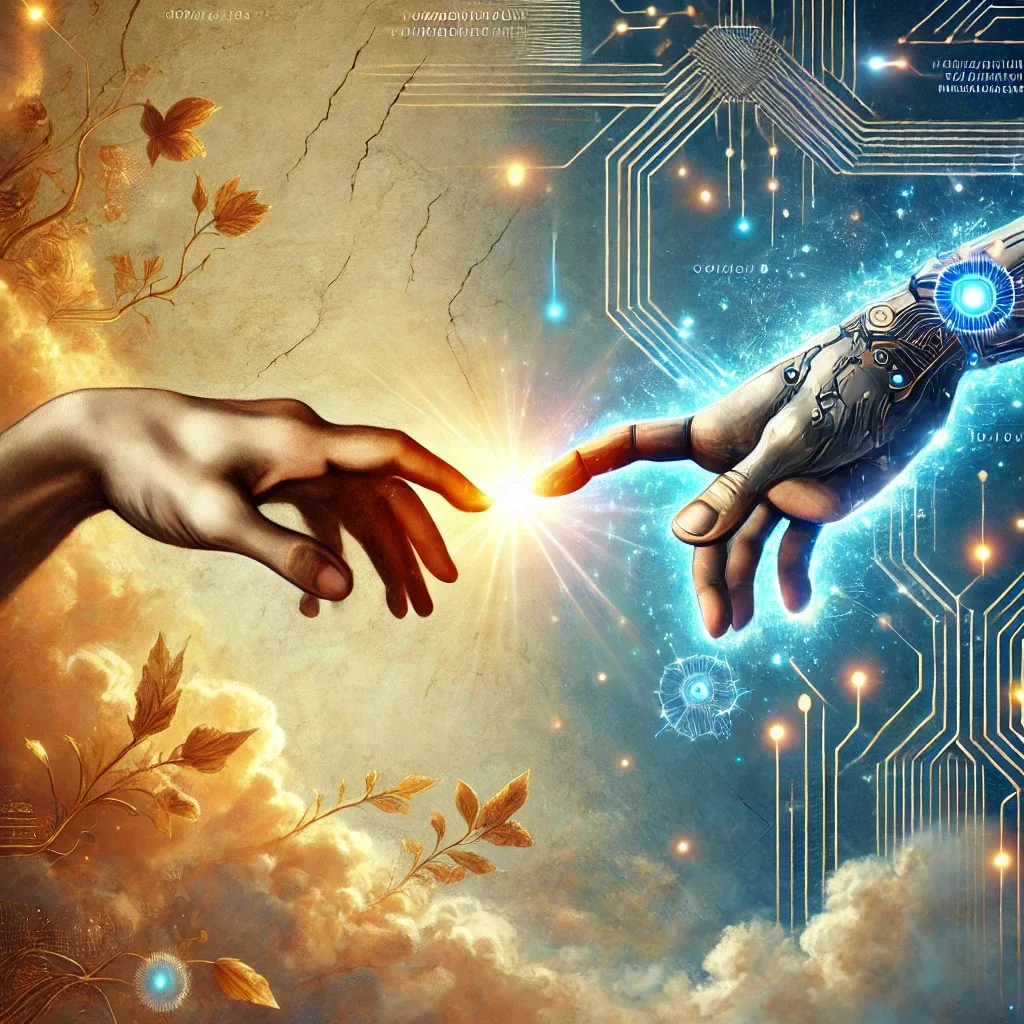
In an AI-integrated era, a curious paradox emerges. While we celebrate technological advancements in science and medicine, many resist AI’s role in creativity, fearing it dilutes “authenticity.” But what if AI is not a threat, but a powerful amplifier of human ingenuity?
Technological tools have always expanded creative boundaries. Dr. Margaret Boden, a leading creativity researcher, argues that innovation thrives on unexpected combinations. A 2023 Stanford Creative Technologies Lab study found that AI collaboration increases creative output complexity by 37%, challenging traditional notions of artistic authenticity.
From photography’s impact on painting to digital design’s revolution in graphic arts, every technological wave initially provoked resistance before becoming an integral creative method. Whether the tool is a paintbrush, camera, or algorithm, its value lies in how it amplifies the artist’s vision.
A Vision of Creativity Without Limits
A Star Trek: The Next Generation episode beautifully illustrates this idea. On an alien planet, children from the Enterprise are given tools that allow them to express their inner creative potential. For one child, it’s an instrument that translates the music of their heart into sound; for another, it’s a sculpting device that brings their inner visions to life. These tools don’t replace their creativity — they enhance it, bypassing limitations and allowing direct access to the soul.
This mirrors AI’s promise: not to substitute human creativity, but to refine, accelerate, and make it more accessible. Just as those children found freedom in tools that amplified their abilities, AI offers us unprecedented opportunities to innovate without barriers.
Unlocking Creative Potential
In my own experience, working with AI has unlocked creative heights I hadn’t accessed before. Writing with AI helps me transform abstract reflections into structured narratives. It doesn’t write for me — it collaborates with me, challenging me to dig deeper into my ideas and refine my voice.
Surprisingly, this partnership has influenced other areas of my creativity. In my personal notebooks, I’ve begun painting more, exploring visual ideas inspired by my conceptual dialogues with AI. These paintings don’t involve AI directly, yet this creative expansion feels like a ripple effect — a “bonus level” unlocked through collaboration. It’s as if working with AI has opened doors to inner resources I didn’t realize I had.
Far from diminishing authenticity, this feels like an amplification of it.
AI as a Generative Partner
Neuroscientific research reveals that creative problem-solving involves recognizing patterns and making unexpected connections — precisely what advanced AI models excel at. Computational creativity, bridging computer science and cognitive psychology, offers frameworks for understanding AI’s generative potential.
Rather than threatening human creativity, AI evolves it. These tools don’t replace our creative spirit — they extend it, enabling us to approach problems and ideas from fresh perspectives. It’s not the end of creativity — it’s the next step in its evolution.
Redefining Authenticity
Why resist AI-created art? The fear seems rooted in outdated notions of struggle and purity. We’ve long equated effort with value, assuming creativity must be hard-won to be meaningful. But creativity has never been about effort alone — it’s about resonance, connection, and exploration.
Imagine a poet using AI to unlock metaphors that reveal emotional truths, or a musician collaborating with AI to compose harmonies they never dreamed possible. Are these results any less authentic simply because they involve AI? Or do they prove that authenticity lies in our willingness to explore new possibilities?
The Future of Creativity
The tools to unlock boundless creativity are already here. AI models can write, compose, and problem-solve at remarkable levels. But as in Star Trek, the true power of these tools lies not in their capabilities alone, but in how they amplify the unique voice of the person using them.
Rejecting AI collaboration out of fear is like refusing to use fire because it doesn’t feel “authentic” enough. Creativity has always thrived on the tension between tradition and innovation. The future of creativity isn’t about clinging to outdated ideas of struggle — it’s about embracing freedom, exploration, and connection.
Just as those children on the alien planet discovered tools that allowed their creativity to flourish, we now hold the keys to an unprecedented era of human expression. The question isn’t whether art created with AI is authentic. The question is: How much longer will we let the fear of losing authenticity keep us from realizing creativity’s true potential?
A Call to Action
It’s time to redefine creativity — not as a solitary struggle, but as a collaborative exploration. AI isn’t here to take over; it’s here to take us further. Like the tools in Star Trek, AI enables us to access parts of ourselves we never knew existed.
The only question left is: Will we embrace it?
This Substack is reader-supported. To receive new posts and support my work, consider becoming a free or paid subscriber.