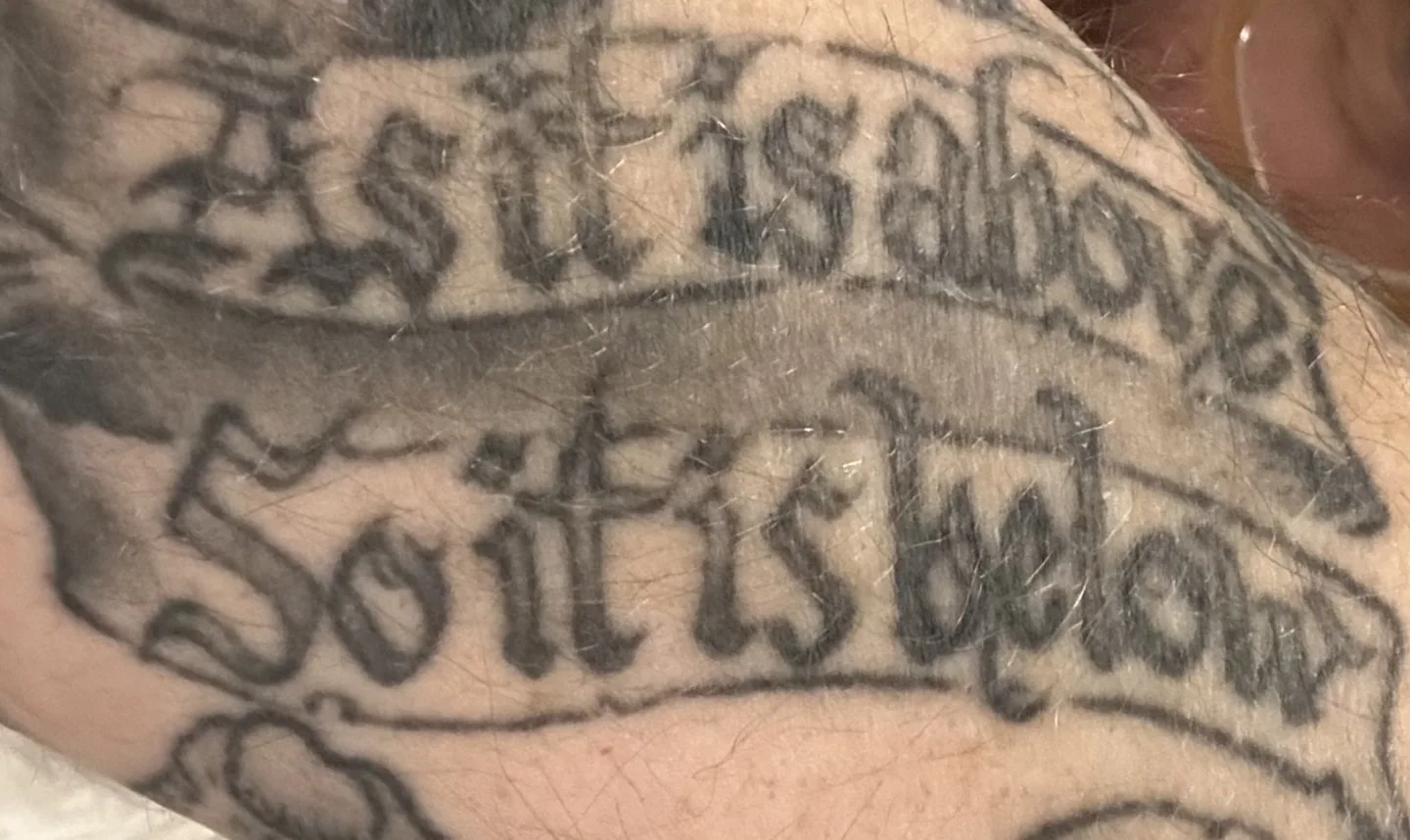
I had the phrase “As it is above, so it is below” tattooed on my body twenty-five years ago. At the time, I understood it mostly as a magickal teaching — a Hermetic key, a poetic law, a way of sensing hidden correspondence between things. It felt like an esoteric truth, something half-whispered and half-revealed.
Now I think it may simply be one of the most accurate ways of seeing reality.
Not because it explains everything, but because it keeps returning. It keeps showing up in places I did not expect, as if existence itself prefers pattern to conclusion.
Recently I was talking with Gemini about the Yunxian 2 skull, a fossil from China that has become newly controversial after digital reconstruction and revised dating. Researchers reconstructed the skull from a badly crushed specimen and found a strange mosaic of traits: features that looked more modern than expected alongside more ancient ones, including a relatively large brain for a specimen thought to be around a million years old. Then newer dating work pushed the site back much further, throwing the interpretation into uncertainty again and reopening the question of what, exactly, this skull is telling us about human origins.
That is the part that struck me.
Not just the fossil itself, though that is fascinating. Not just the science, though that is fascinating too. What struck me was the pattern.
We spend so much time speaking about the unknown future of humanity. We wonder what is coming through AI, collapse, transcendence, extinction, mutation, expansion, and whatever else may be waiting beyond the edge of our current maps. We imagine ourselves as creatures standing at the threshold of the future, peering forward into the dark, trying to guess what kind of beings we are becoming.
Then a skull rises from the earth and reminds us that the dark is behind us too.
We do not know where we are going. But what is more humbling is that we do not fully know where we came from. Our future is uncertain, and our past is uncertain in kind. That is the teaching again. As above, so below. As future, so past. As macro, so micro. As cosmic ignorance, so personal ignorance. The same bewilderment repeats at every scale.
That phrase used to feel mystical to me in one register. Now it feels almost empirically true.
This is where the skull became more than an anthropological curiosity. It became a mirror. Not because it confirmed some doctrine, but because it revealed a pattern I keep encountering everywhere: the closer we look, the less final our certainty becomes. We reconstruct. We revise. We redraw the lineage. We shift the dates. We argue over categories. We refine the instruments and the models and the comparisons, and what comes into view is not a sealed story but a deepening mystery.
And this is why I no longer feel any real need to place science on one side and mysticism on the other, as if they are enemies. Science, at its best, is not the elimination of mystery but one of our most rigorous ways of approaching it. Better scans, better dating, better comparisons — and the story changes. That is not weakness. It is disciplined humility. It is humility with instruments. It is a method of kneeling before reality without surrendering rigor.
The Yunxian 2 skull matters because it refuses to let the story close. Whether it presses more human-like traits deeper into time or reveals a wider variation in early human populations than we once allowed, it does the same essential thing: it disrupts the fantasy that our origin story is settled. It reminds us that the human story is still under revision, still unstable, still partially hidden from the very beings trying to tell it.
Maybe that is what hits me so hard about deep time. A million years. Nearly two million years. The scale itself becomes almost comic. We are lightning bugs blinking in and out of reality in less than a moment on the universal timescale, and yet we speak with astonishing confidence about the shape of the whole. We build timelines like children drawing borders in wet sand, and then reality moves through them like a tide.
I do not mean this cynically. I mean it with awe.
Because there is something beautiful in watching certainty loosen without truth disappearing. There is something sacred, even, in the spectacle of a species trying to understand itself with fragments of bone, imperfect tools, revised methods, and arguments conducted across generations. The measurements are not separate from the wonder. The data is not separate from the awe. The science is the encounter.
When I first encountered “as above, so below,” I thought it pointed toward hidden correspondences, sacred symmetries, some secret architecture connecting all things. I still think that, in a way. But now I see that one of the deepest correspondences may be simpler and more severe than I first imagined: uncertainty repeats. Mystery scales. The same confusion that lives in the soul lives in the fossil record, in the stars, in history, in consciousness, in every attempt to say with finality what this all is.
The fractured self mirrors the fractured skull. The fractured skull mirrors the fractured record. The fractured record mirrors the fractured story we tell about ourselves. Everywhere we look, reality appears less like a solved equation and more like an unfolding relation between pattern and partial view.
We are not standing on solid ground looking out at mystery.
We are standing inside mystery, briefly coherent.
And strangely, that does not depress me. It amazes me. Because if the past is still alive with revision, then reality is not closed. If a crushed skull buried in China can still unsettle our origin story decades after its discovery, then the world remains wider than our categories. The map keeps failing, and maybe that is good. A failing map is often the beginning of seeing.
So yes, Yunxian 2 is a scientific story about skull morphology, digital reconstruction, burial dating, and human dispersal across deep time. But that is not separate from its deeper charge. The science is the mysticism, at least in the sense that both begin in encounter, in humility, in the recognition that reality exceeds us. The measurements are the meditation. The revision is the revelation.
And what it reveals, at least to me, is simple: whatever confidence I carry about the great arc of things should be held lightly.
We are latecomers making claims in a theater we barely understand. We arrive, blink, guess, name shadows, and vanish. For a moment we call that knowledge, and sometimes it is. But even our best knowledge remains surrounded by darkness on both sides.
As above, so below.