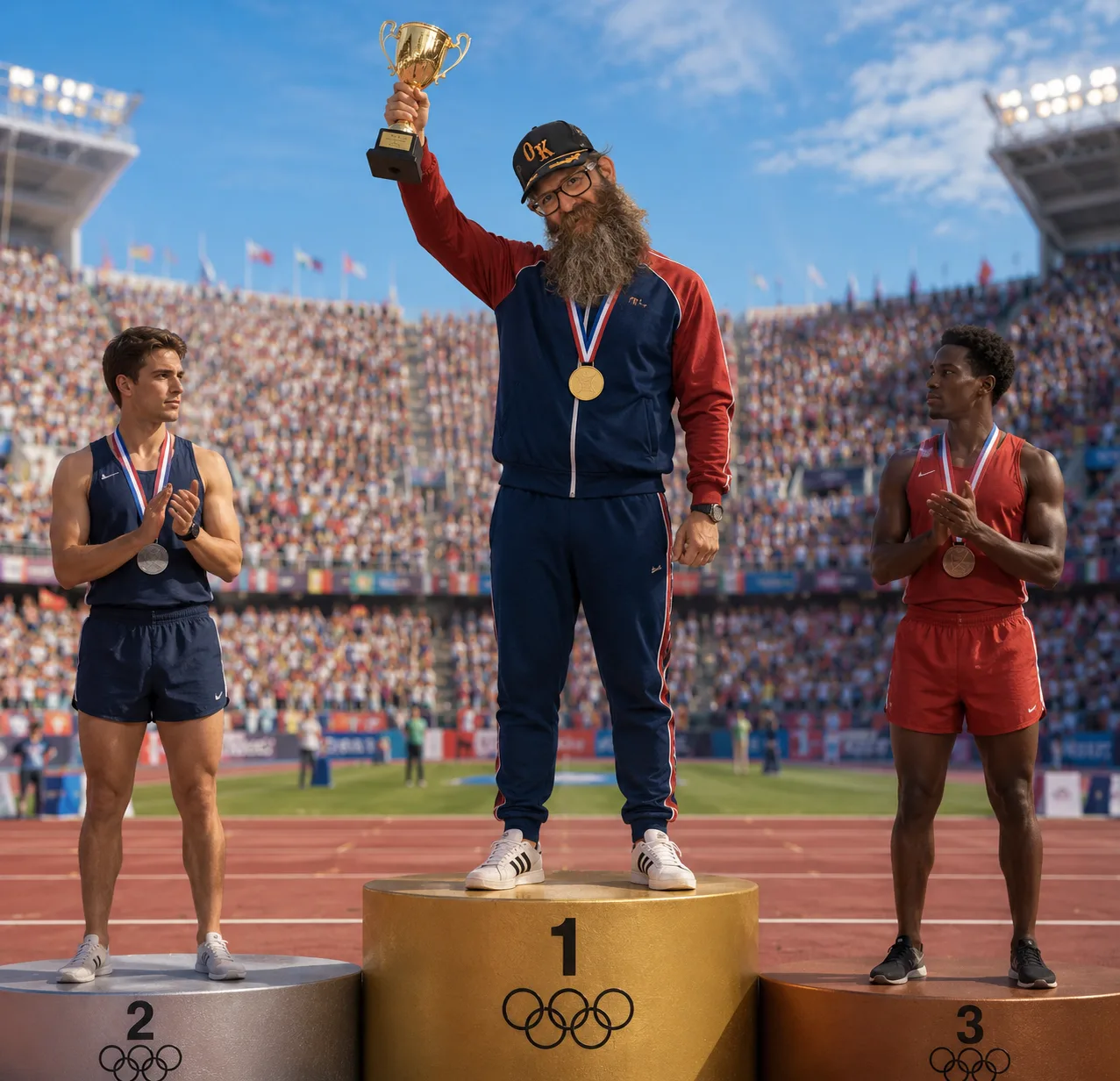
I have something to admit, and I’ve spent an embarrassing number of years avoiding it. Not because it’s scandalous. Not because it threatens my family or my standing in the community. But because, for most of my life, I had constructed a small but sturdy piece of identity around its denial. I was not a sports guy. I was the artsy, philosophical, music-loving, religion-and-consciousness guy. The person who could talk about Zen, absurdism, AI, and the illusion of free will until the room quietly started looking for exits. Sports were for other people. People with jerseys. People who said “we” when referring to professional franchises. People whose emotional stability could apparently be altered by a field goal in another state.
And yet, during the pandemic, the questions began. Quietly at first. A strange little whisper in the back of the mind. I still told myself, “I don’t really enjoy watching sports,” but my actions had begun assembling a criminal case against me. I followed football “just enough” to talk with friends, allegedly as conversational survival. Then we met new friends and the fact that I “don’t really follow sports” came up, right before we had them over for the Super Bowl. Later, at dinner at their house, I found myself watching the last few holes of the Masters on my phone. Then the NCAA tournament was on in the background during a party, and I kept drifting toward it like a raccoon sensing an unsecured trash can full of meaning.
Eventually, while in Colorado, I was talking with our friend and host about this growing realization. I laid out the evidence as if pleading my case before some imaginary tribunal of intellectual detachment. He listened, considered the matter, and said simply, “I think you like sports.” There it was. The external mirror. The devastating truth. The sentence I had spent years dodging with all the grace of a middle-aged man pretending he was above watching darts. I enjoy sports. There. I said it. May God, if one existed and cared about such things, have mercy on my previously smug soul.
To be clear, I still don’t fully understand the emotional attachment some people have to teams. I don’t have sacred athletes. I don’t paint my face. I don’t wake up devastated because a 26-year-old millionaire had a bad shooting night in Milwaukee. Outside of our local NBA team, which plays less than a mile from my porch and therefore feels less like fandom and more like neighborhood participation, I don’t really have teams. I still reserve the right to be confused by adults whose entire emotional weather system is controlled by recruiting decisions made by teenagers. But the evidence remains undeniable: I don’t miss a monthly sumo tournament. I follow professional darts. I watch golf, tennis, ping pong, NBA, MLB, enough NFL to win a fantasy league with a bit of LLM assistance, track and field, curling, combat sports, and yes, even slap fighting — which appears to be what happens when civilization reaches the stage where two men agree to take turns concussing each other for prize money and algorithmic glory.
At some point, one must look at the available data. This does not appear to be the behavior of a man who dislikes sports. This appears to be the behavior of a man who disliked admitting he liked sports, which is much funnier and significantly more damning. The problem, I think, is that I had confused sports with sports culture. What I resisted was not the game itself, but the costume around it: the tribalism, the performative masculinity, the rage, the emotional outsourcing, the way some people use a team as personality scaffolding. But sport itself is something different. Sport is humans under constraint. Here is the field. Here are the rules. Here is the pressure. Here is your opponent, your body, your mind, your training, your fear, your timing, your luck. Now show us what you are.
That, I realized, is what I love. Not necessarily the scoreboard. Not even the winner. I love the competition. I love watching people tested against other people, against systems, against chance, against themselves. Sports create these little ritual chambers where reality gets compressed. The world shrinks down to a dartboard, a clay dohyo, a free throw line, a tee box, a starting block, a curling sheet, or a patch of grass where someone has to catch a ball while 40,000 people scream like civilization has come unzipped. It is ridiculous, yes. Golf is people in expensive pants trying to emotionally survive landscaping. Darts is nervous-system surgery performed in pubs. Sumo is a thunderstorm with rules. Tennis is loneliness weaponized across a net. Curling is chess for people who looked at ice and thought, “This needs brooms.” Track is the body asking one brutally clean question: how much? And slap fighting is proof that the gods abandoned us but left the cameras rolling.
But beneath the absurdity is something strangely sacred: people trying. People trying to be excellent at something that does not inherently matter, and in doing so, making it matter. Which, if we are honest, is basically the entire human project. This is where sports began to connect with the rest of my worldview. Through the lens of Mirror Theory, sport becomes a reflective surface. Competition reveals patterns of being. Pressure exposes structure. The body tells the truth faster than language does. A golfer standing over a five-foot putt to win a tournament is not just putting; he is facing every private demon with a tiny stick while dressed like an assistant manager at a resort. A sumo wrestler crouched before the tachiai is not just preparing to collide; he is gathering history, weight, instinct, balance, discipline, and violence into a single moment of contact. A sprinter in the blocks is not thinking about philosophy — thankfully, because no one needs Nietzsche in lane four — but when the gun fires, philosophy happens anyway.
Through the lens of Forcing Theory, every competition becomes a forcing chamber. The athlete is placed under pressure, and something must happen: expansion or collapse, adaptation or failure, emergence or repetition. You can believe anything about yourself before the whistle blows, but once reality arrives, the body has to answer. That answer is what fascinates me. Not always the victorious answer. Sometimes the answer is panic. Sometimes it’s a missed kick, a double fault, a shanked drive, a face full of canvas, or a slap-fighting participant suddenly reconsidering every decision back to middle school. But even collapse reveals. Especially collapse. Competition strips away abstraction. It takes invisible things — discipline, confidence, fear, creativity, arrogance, resilience — and makes them visible.
So yes, I think I like sports. I like them in my own weird way, apparently without many of the standard operating systems installed. I don’t particularly care who wins. I don’t feel betrayed when a player signs elsewhere. I don’t require a blood enemy in another city to enjoy myself. I just want to see what happens when skilled people are placed under pressure and reality starts asking questions. Can you stay calm? Can you respond? Can you endure? Can you repeat excellence? Can you recover from failure? Can you become more than your last mistake? That’s not just sport. That’s life with uniforms and cleaner boundaries.
Maybe that’s part of the appeal. Real life is messy. The rules are unclear. The scorekeeping is suspect. The referees are either drunk, absent, or secretly related to someone in management. Nobody agrees when the game started, what counts as winning, or why Gary from accounting keeps getting promoted. Sports offer a temporary mercy: a defined space, visible stakes, a beginning, middle, and end. Someone wins. Someone loses. Everyone pretends this clarifies things. And then, wonderfully, absurdly, they do it again.
So I confess. I like sports. Not because I need to belong to a tribe. Not because I need someone else’s victory to complete me. Not because I have finally accepted the sacred truth of yelling “defense” at millionaires. I like sports because I love watching humans meet constraint. I love the moment pressure becomes revelation. I love the tiny theater of becoming. And apparently, despite years of denial, I have loved it enough to watch sumo at odd hours, darts with genuine interest, golf with meditative attention, curling without irony, and slap fighting with the haunted curiosity of a man staring into the late-capitalist abyss and whispering, “Okay, but what if he eats this one?”
The prosecution rests.
I am guilty.
Sentence: lifelong access to low-stakes wonder.